Introduction to the Linear Model

DPUK Spring Academy

Josiah King, Umberto Noe, (and credits to Tom Booth)

Department of Psychology
The University of Edinburgh

2025-04-01

Overview

  • Day 2: What is a linear model?
  • Day 3: But I have more variables, what now?
  • Day 4: Interactions
  • Day 5: Is my model any good?

Day 3

But I have more variables, now what?

  • Part 1 - Quick Recap
  • Part 2 - Explaining variance
  • Part 3 - More predictors
  • Part 4 - More variance explained? (model comparison)
  • Part 5 - Coefficients

Quick recap

Models

deterministic

given the same input, deterministic functions return exactly the same output

  • area of sphere = \(4\pi r^2\)

  • height of fall = \(1/2 g t^2\)

statistical

\[ \color{red}{\textrm{outcome}} \color{black}{=} \color{blue}{(\textrm{model})} + \color{black}{\textrm{error}} \]

  • handspan = height + randomness

  • cognitive test score = age + premorbid IQ + … + randomness

The Linear Model

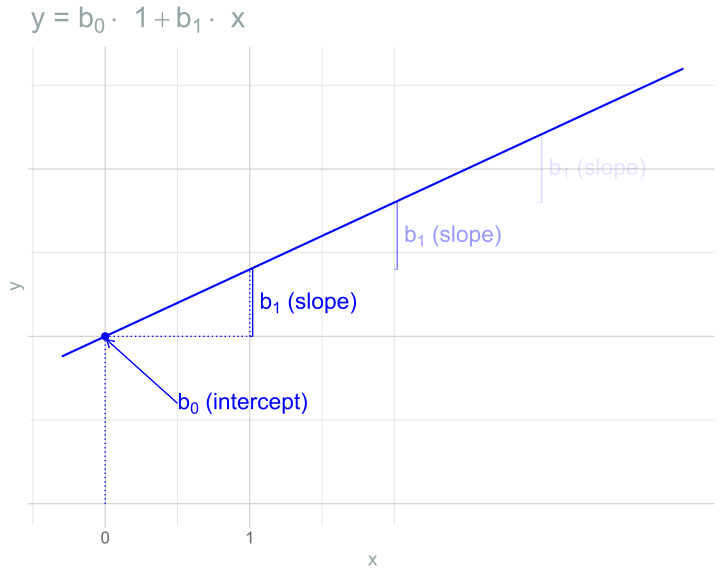
\[ \begin{align} \color{red}{\textrm{outcome}} & = \color{blue}{(\textrm{model})} + \textrm{error} \\ \qquad \\ \qquad \\ \color{red}{y_i} & = \color{blue}{b_0 \cdot{} 1 + b_1 \cdot{} x_i} + \varepsilon_i \\ \qquad \\ & \text{where } \varepsilon_i \sim N(0, \sigma) \text{ independently} \\ \end{align} \]

The Linear Model

Our proposed model of the world:

\(\color{red}{y_i} = \color{blue}{b_0 \cdot{} 1 + b_1 \cdot{} x_i} + \varepsilon_i\)

The Linear Model

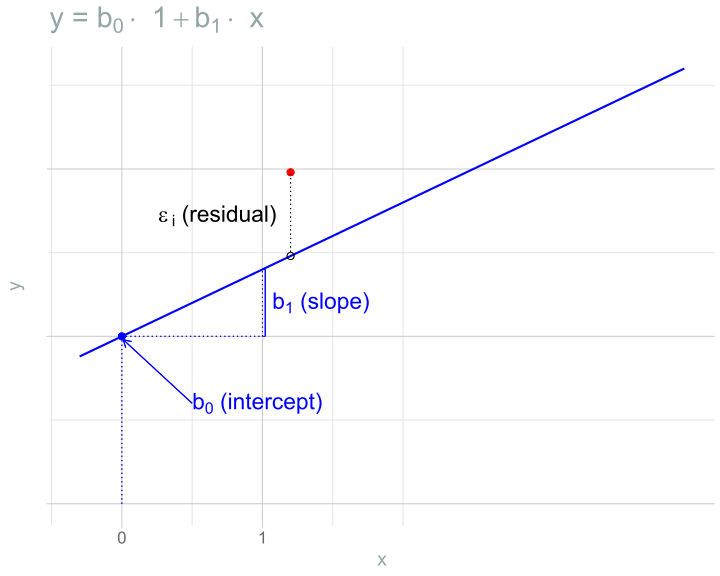
Our model \(\hat{\textrm{f}}\textrm{itted}\) to some data:

\(\hat{y}_i = \color{blue}{\hat b_0 \cdot{} 1 + \hat b_1 \cdot{} x_i}\)

For the \(i^{th}\) observation:

  • \(\color{red}{y_i}\) is the value we observe for \(x_i\)
  • \(\hat{y}_i\) is the value the model predicts for \(x_i\)
  • \(\color{red}{y_i} = \hat{y}_i + \hat\varepsilon_i\)
An example

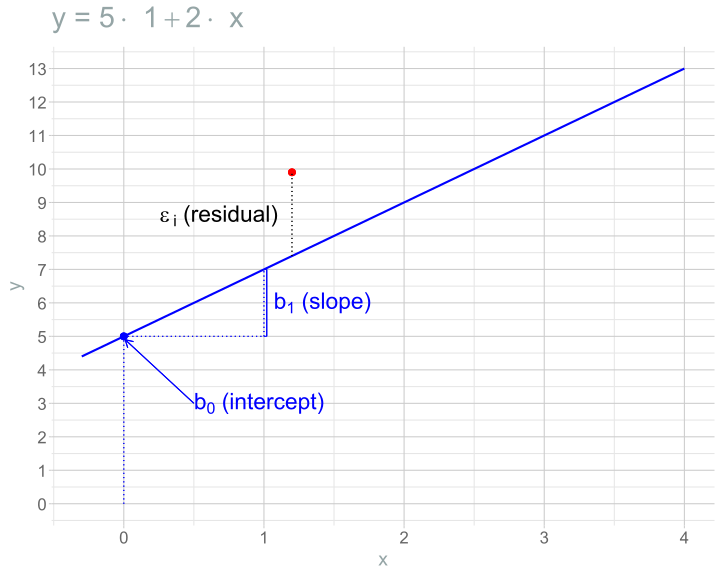
Our model \(\hat{\textrm{f}}\textrm{itted}\) to some data:

\(\color{red}{y_i} = \color{blue}{5 \cdot{} 1 + 2 \cdot{} x_i} + \hat\varepsilon_i\)

For the observation \(x_i = 1.2, \; y_i = 9.9\):

\[ \begin{align} \color{red}{9.9} & = \color{blue}{5 \cdot{}} 1 + \color{blue}{2 \cdot{}} 1.2 + \hat\varepsilon_i \\ & = 7.4 + \hat\varepsilon_i \\ & = 7.4 + 2.5 \\ \end{align} \]
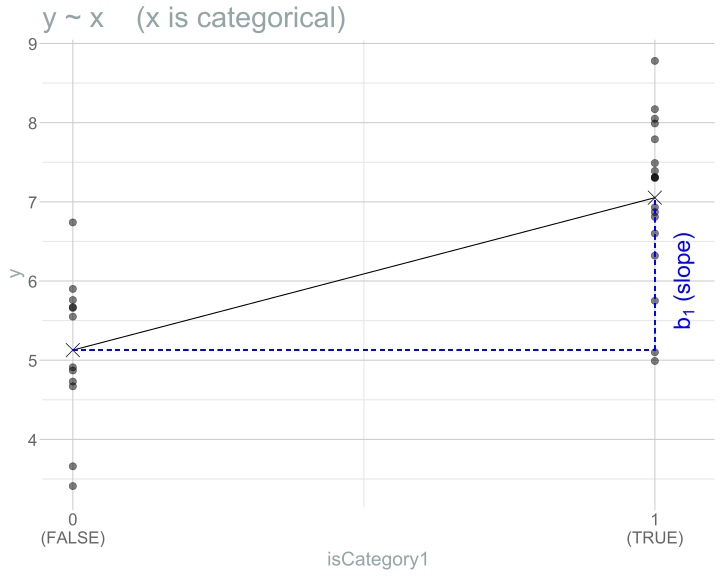
Categorical Predictors

y x
7.99 Category1
4.73 Category0
3.66 Category0
3.41 Category0
5.75 Category1
5.66 Category0
... ...

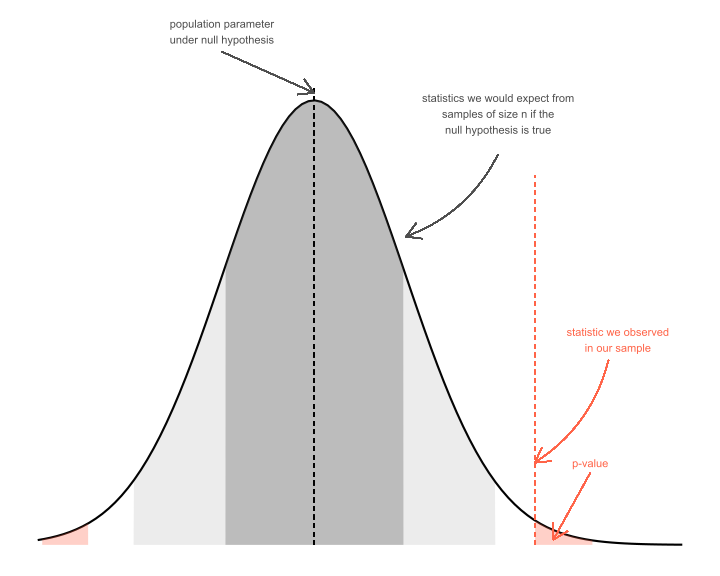
Null Hypothesis Testing

Null Hypothesis Testing
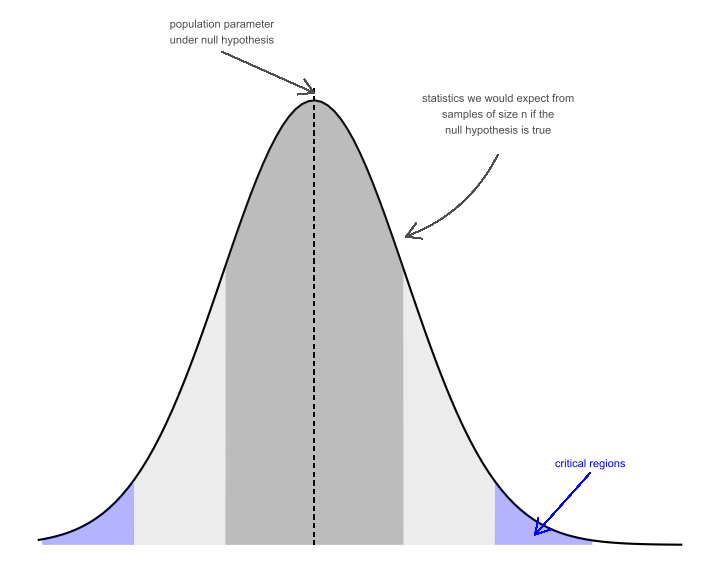
test of individual parameters
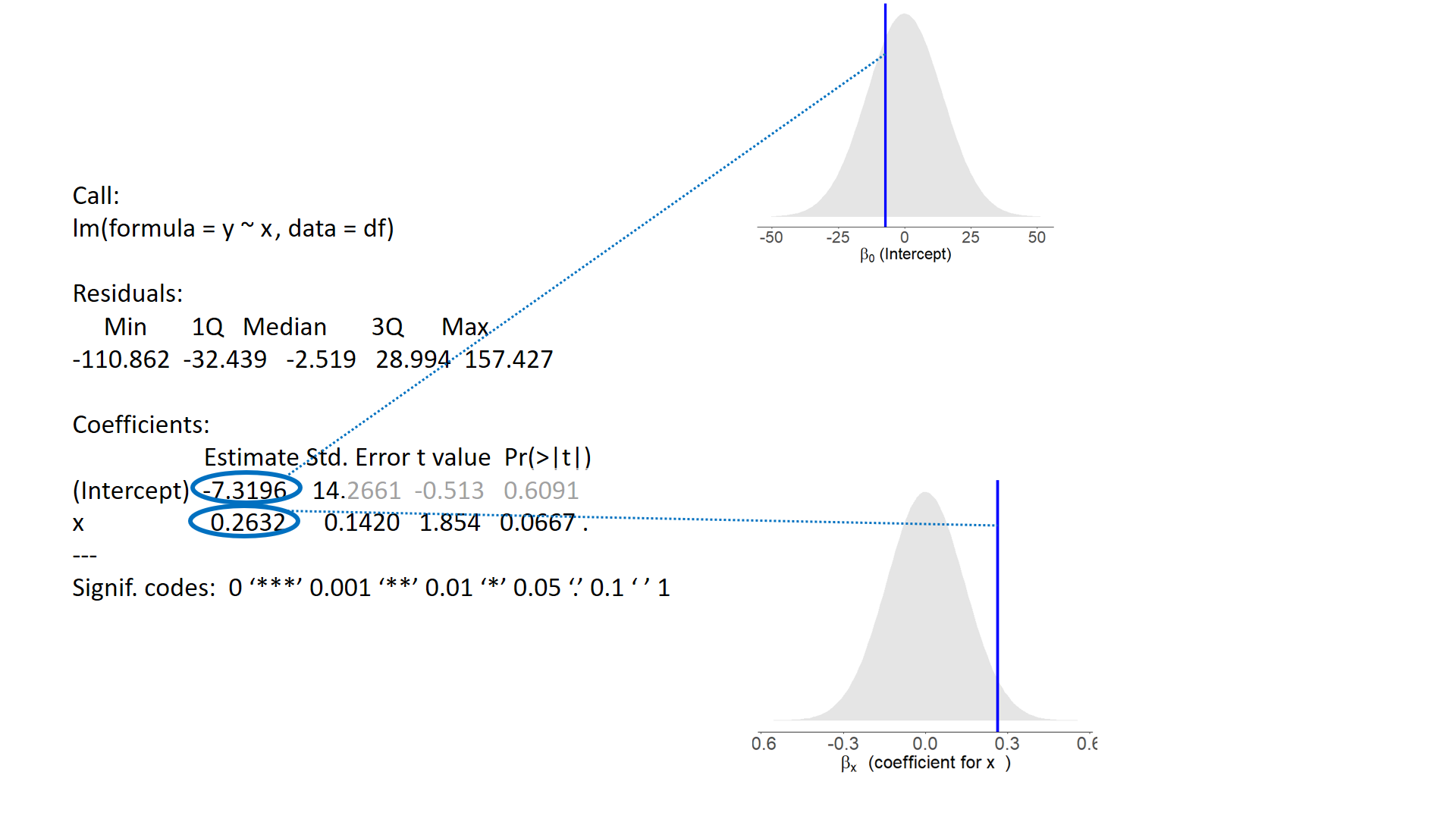
test of individual parameters (2)
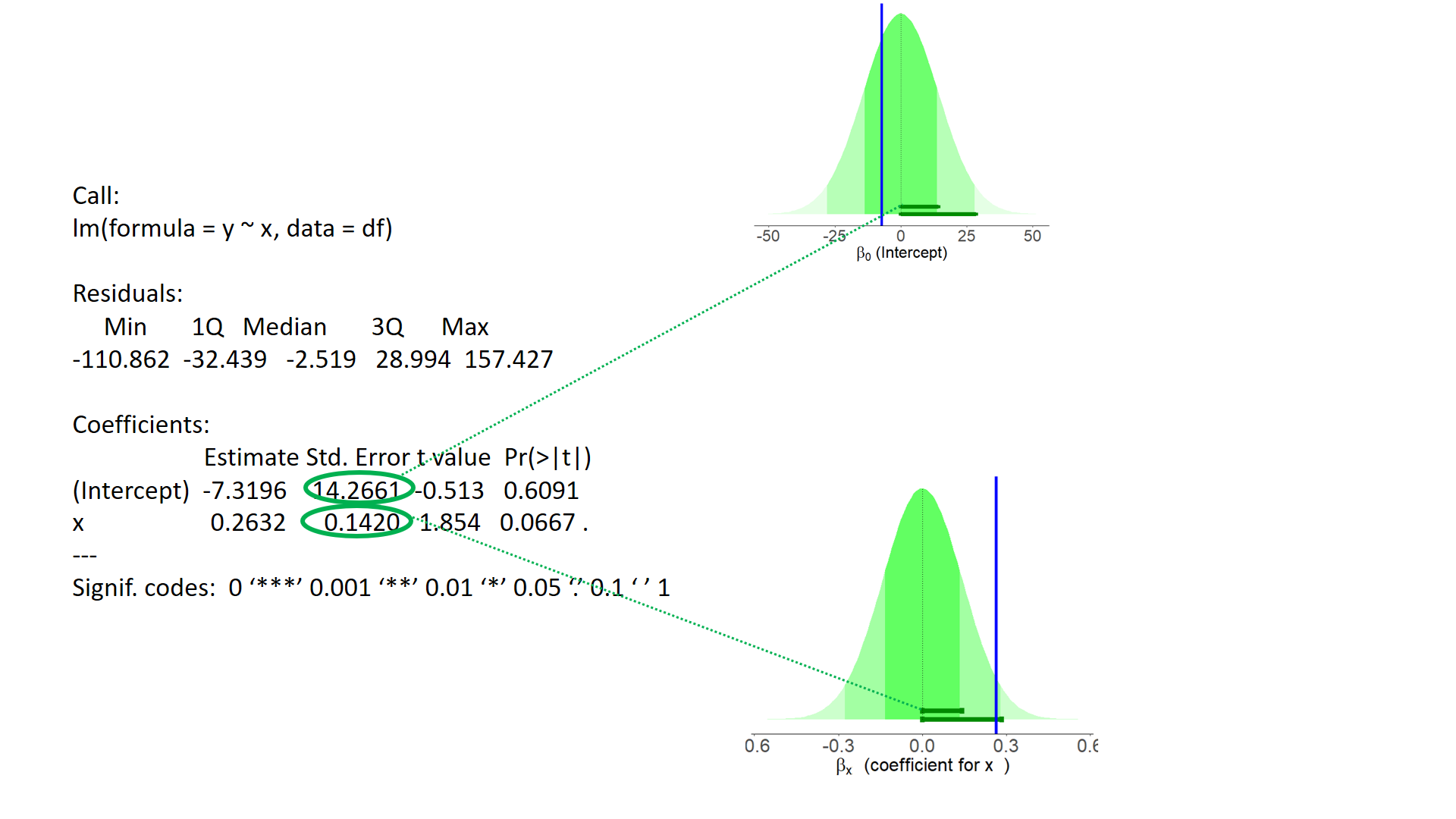
test of individual parameters (3)
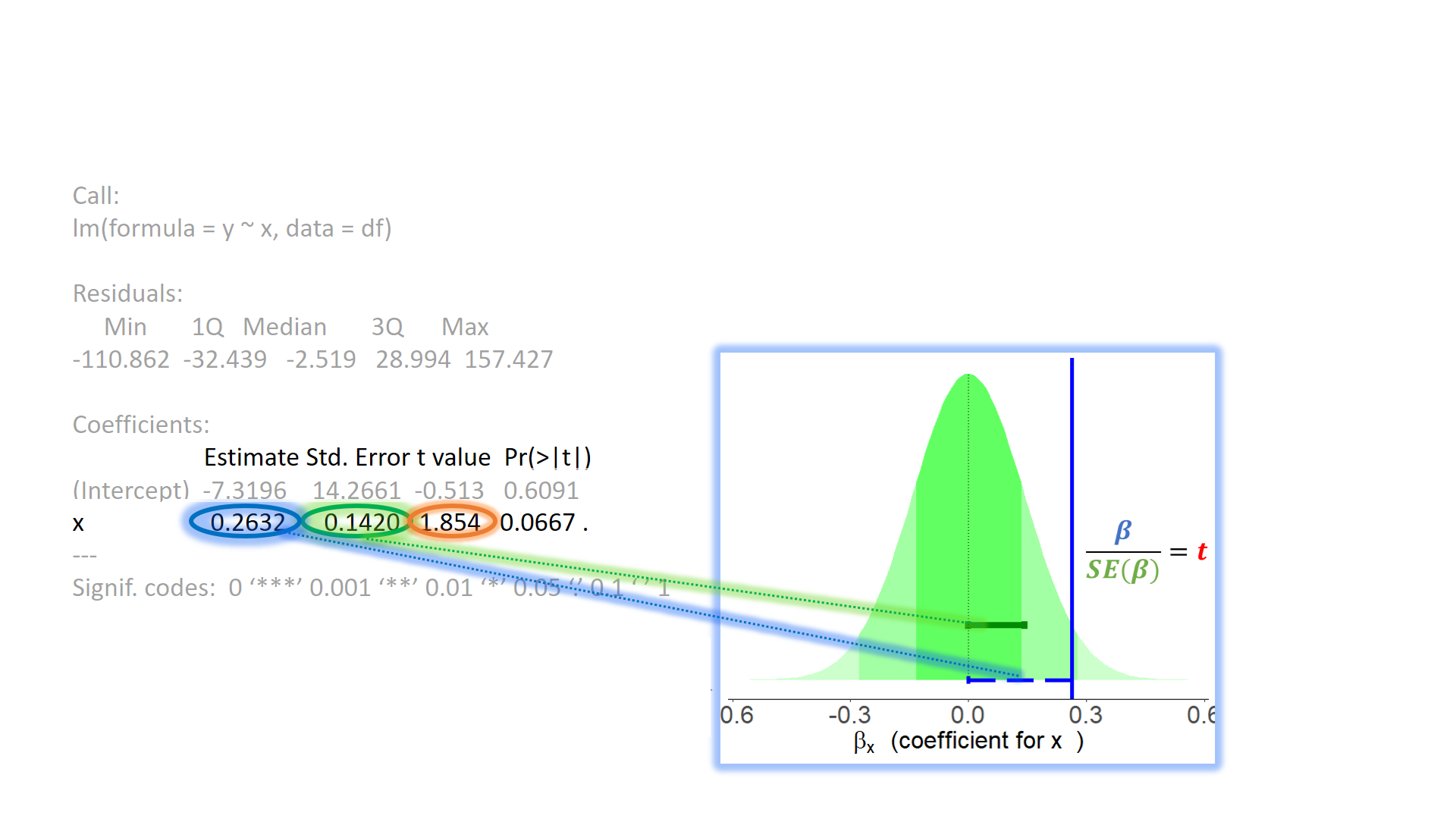
test of individual parameters (4)
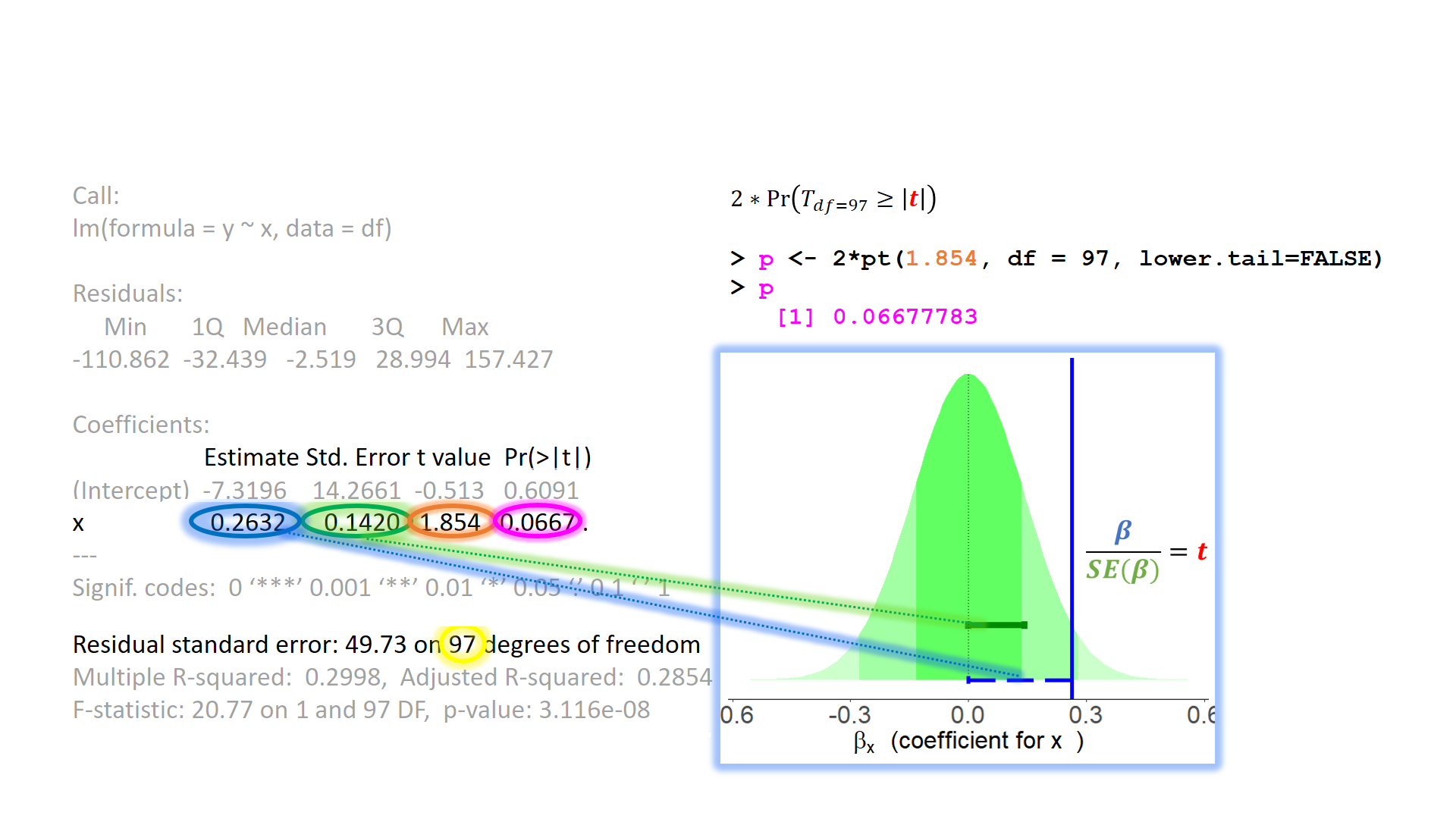
The linear model as variance explained

Sums of Squares

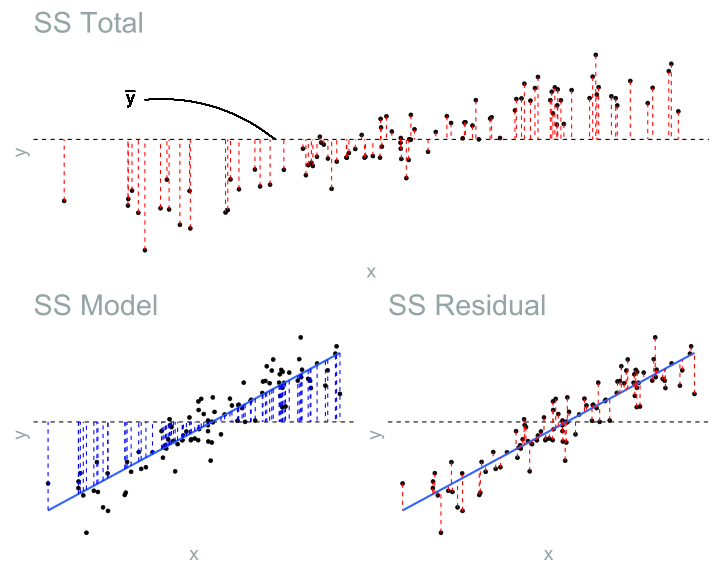
Rather than focussing on slope coefficients, we can also think of our model in terms of sums of squares (SS).

  • \(SS_{total} = \sum^{n}_{i=1}(y_i - \bar y)^2\)

  • \(SS_{model} = \sum^{n}_{i=1}(\hat y_i - \bar y)^2\)

  • \(SS_{residual} = \sum^{n}_{i=1}(y_i - \hat y_i)^2\)
\(R^2\)

\(R^2 = \frac{SS_{Model}}{SS_{Total}} = 1 - \frac{SS_{Residual}}{SS_{Total}}\)

mdl <- lm(y ~ 1 + x, data)
summary(mdl)
...

Coefficients:
            Estimate Std. Error t value Pr(>|t|)   
(Intercept)   ...       ...      ...    ...
x             ...       ...      ...    ...
...

...
Multiple R-squared:  0.66,  Adjusted R-squared:  0.657
...

F-ratio

\[ \begin{align} & F_{df_{model},df_{residual}} = \frac{MS_{Model}}{MS_{Residual}} = \frac{SS_{Model}/df_{Model}}{SS_{Residual}/df_{Residual}} \\ & \quad \\ & \text{Where:} \\ & df_{model} = k \\ & df_{residual} = n-k-1 \\ & n = \text{sample size} \\ & k = \text{number of explanatory variables} \\ \end{align} \]

mdl <- lm(y ~ 1 + x, data)
summary(mdl)
...

Coefficients:
            Estimate Std. Error t value Pr(>|t|)   
(Intercept)   ...       ...      ...    ...
x             ...       ...      ...    ...
...

...
Multiple R-squared:  0.66,  Adjusted R-squared:  0.657
F-statistic:  190 on 1 and 98 DF,  p-value: <2e-16
  • \(F\)-ratio tests the null hypothesis that all the regression slopes in a model are zero

  • a ratio of the explained to unexplained variance

  • Mean squares are sums of squares calculations divided by the associated degrees of freedom.

  • The degrees of freedom are defined by the number of “independent” values associated with the different calculations.

  • Bigger \(F\)-ratios indicate better models.

    • It means the model variance is big compared to the residual variance.

F-test

  • testing the F-ratio

  • The null hypothesis for the model says that the best guess of any individuals \(y\) value is the mean of \(y\) plus error.

    • Or, that the \(x\) variables carry no information collectively about \(y\).
  • \(F\)-ratio will be close to 1 when the null hypothesis is true

    • If there is equivalent residual to model variation, \(F\)=1
      • If there is more model than residual \(F\) > 1
  • \(F\)-ratio is then evaluated against an \(F\)-distribution with \(df_{Model}\) and \(df_{Residual}\) and a pre-defined \(\alpha\)

how does this all help?

  • The aim of a linear model is to explain variance in an outcome.

  • In simple linear models, we have a single predictor, but the model can accommodate (in principle) any number of predictors.

  • However, when we include multiple predictors, those predictors are likely to correlate

  • Thus, a linear model with multiple predictors finds the optimal prediction of the outcome from several predictors, taking into account their redundancy with one another

how does this all help?

  • how does \(R^2\) change with the addition of our predictor of interest beyond the variance explained by other variables

  • does the inclusion of our predictor of interest significantly improve model fit beyond the variance explained by other variables

More predictors

Uses of multiple regression

  • For prediction: multiple predictors may lead to improved prediction.

  • For theory testing: often our theories suggest that multiple variables together contribute to variation in an outcome

  • For covariate control: we might want to assess the effect of a specific predictor, controlling for the influence of others.

    • E.g., effects of personality on health after removing the effects of age and sex

Third variables

Third variables

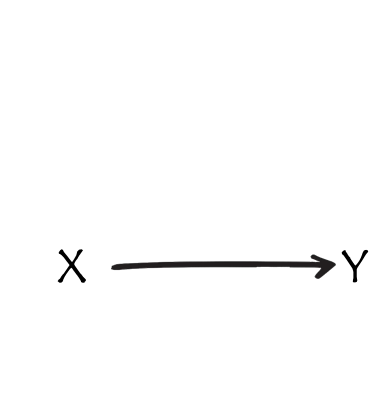
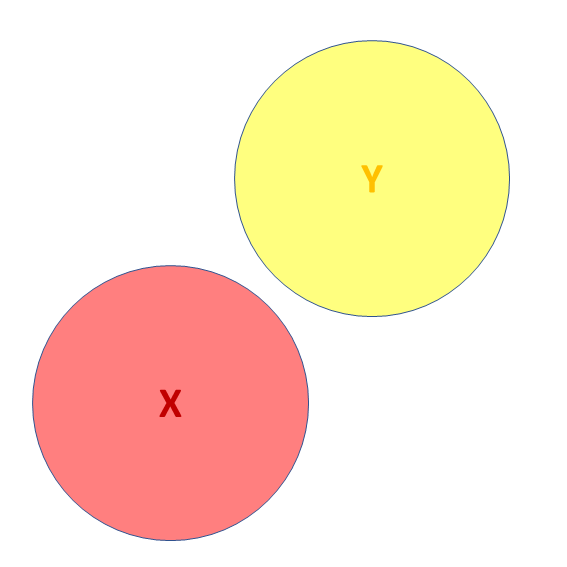
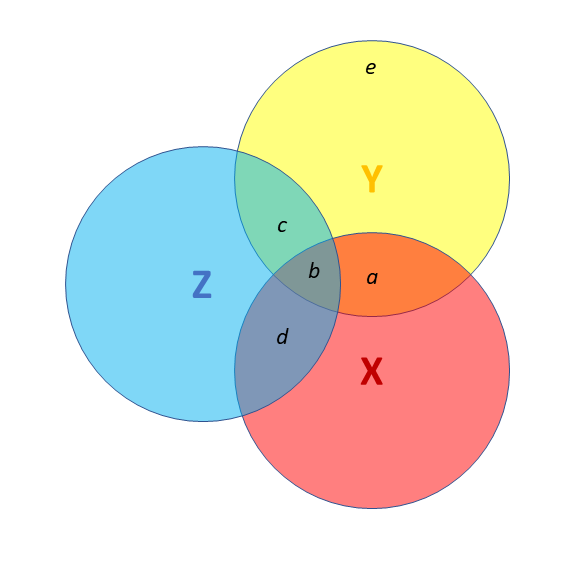
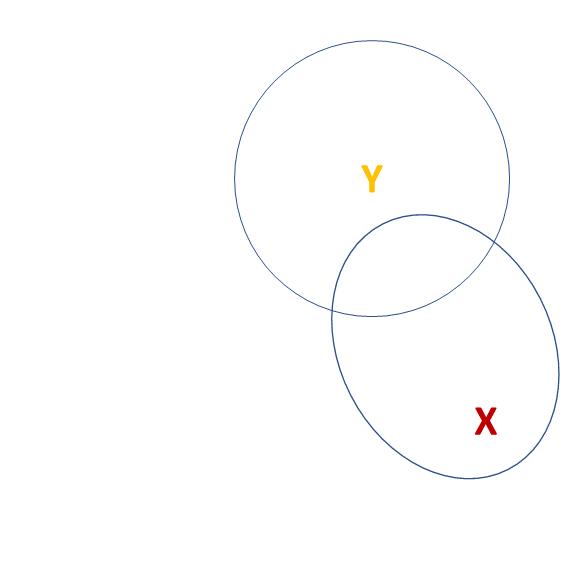
  • X and Y are ‘orthogonal’ (perfectly uncorrelated)
Third variables

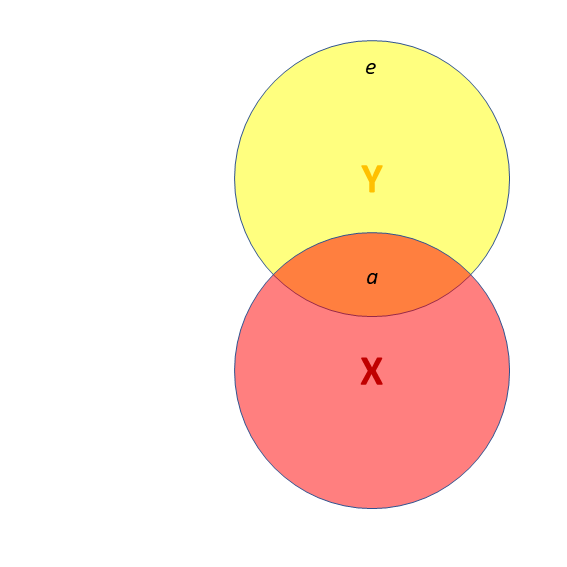
  • X and Y are correlated.
    • a = portion of Y’s variance shared with X
    • e = portion of Y’s variance unrelated to X
Third variables

  • X and Y are correlated.
    • a = portion of Y’s variance shared with X
    • e = portion of Y’s variance unrelated to X
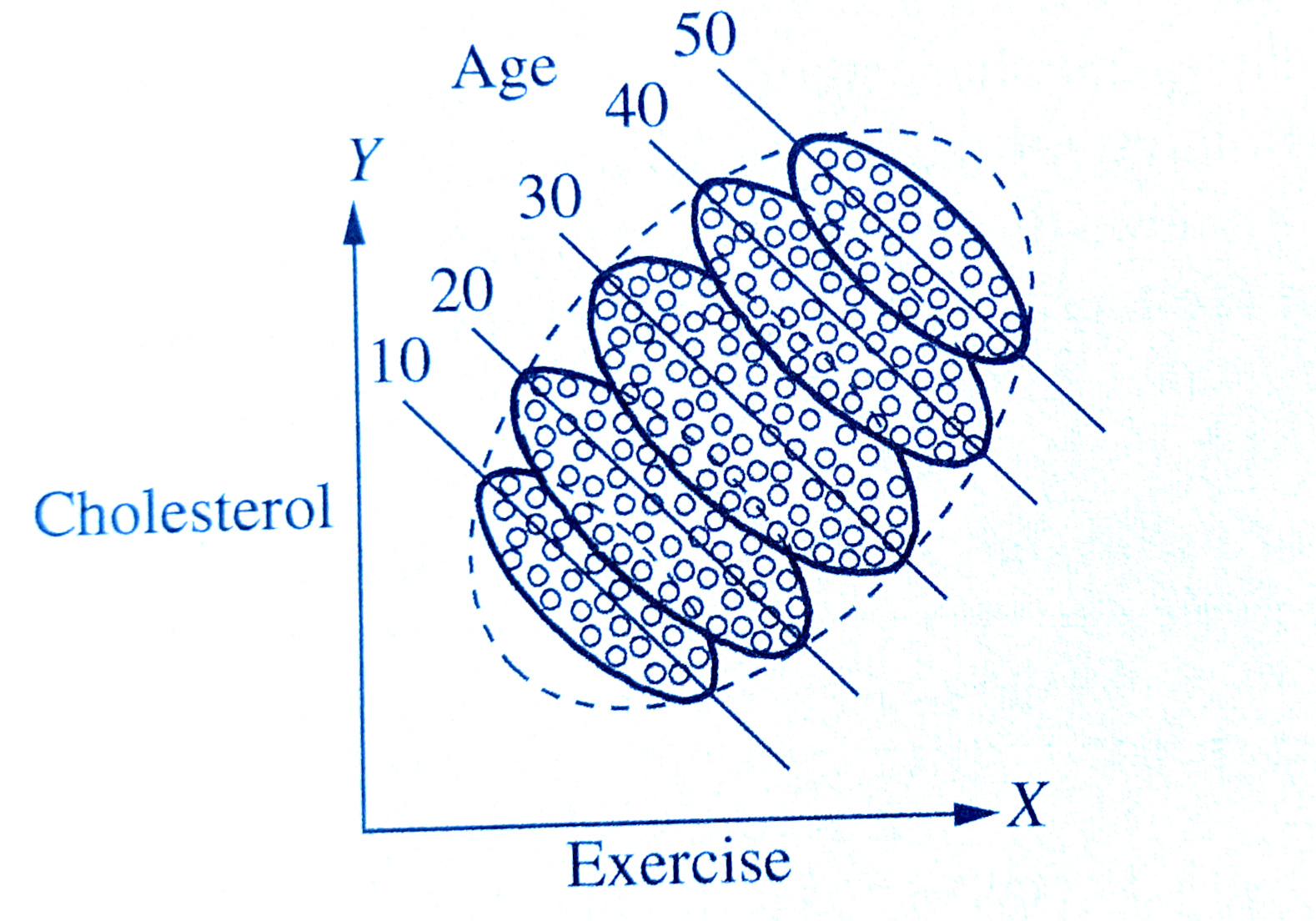
  • Z is also related to Y (c)
  • Z is orthogonal to X (no overlap)
  • relation between X and Y is unaffected (a)
  • unexplained variance in Y (e) is reduced, so a:e ratio is greater.

Design is so important! If possible, we could design it so that X and Z are orthogonal (in the long run) by e.g., randomisation.
Third variables

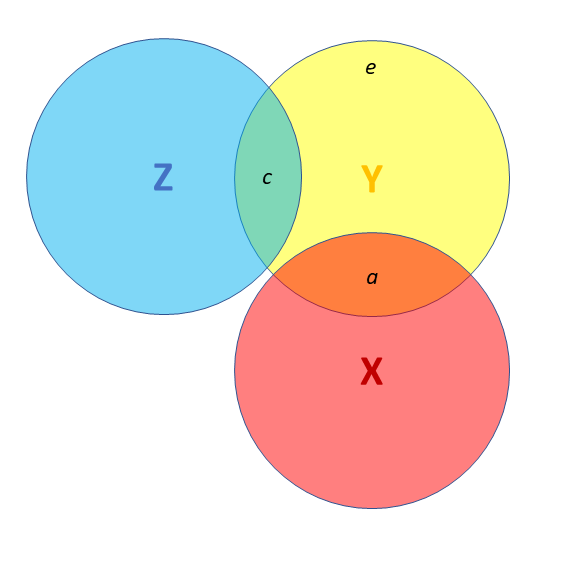
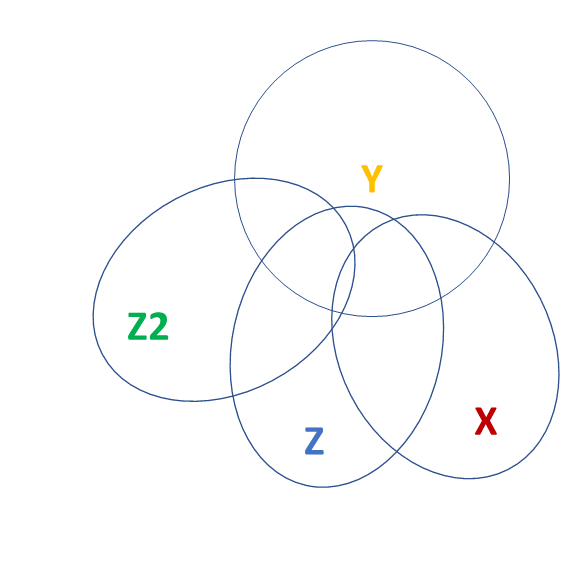
  • X and Y are correlated.


  • Z is also related to Y (c + b)
  • Z is related to X (b + d)

Association between X and Y is changed if we adjust for Z (a is smaller than previous slide), because there is a bit (b) that could be attributed to Z instead.

  • multiple regression coefficients for X and Z are like areas a and c (scaled to be in terms of ‘per unit change in the predictor’)
  • total variance explained by both X and Z is a+b+c
I have control issues..

..and so should you

what do we mean by “control”?

  • often quite a vague/nebulous idea

relationship between x and y …

  • controlling for z
  • accounting for z
  • conditional upon z
  • holding constant z
  • adjusting for z

I have control issues..

..and so should you

  • linear regression models provide “linear adjustment” of Z

    • sort of like stratification across groups, but Z can now be continuous

    • assumes effect of X on Y is constant across Z

      • (but doesn’t have to, as we’ll see tomorrow)

I have control issues..

..and so should you

In order to estimate “the effect” of X on Y, deciding on what to control for MUST rely on a theoretical model of causes - i.e. a theory about the underlying data generating process

thus far - lm(y~x)

what do i do?

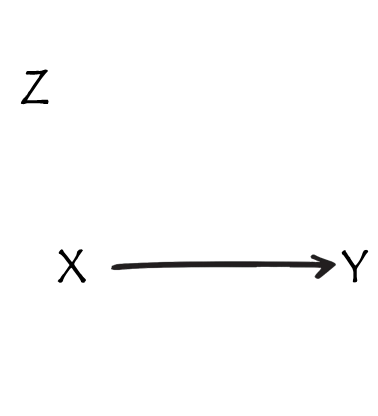
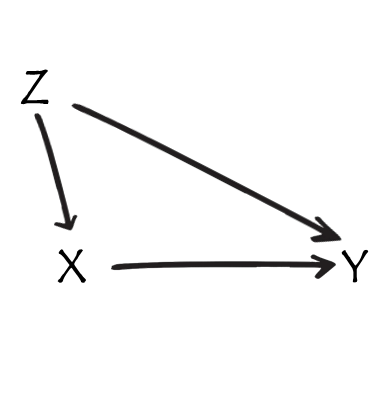
Z is a confounder
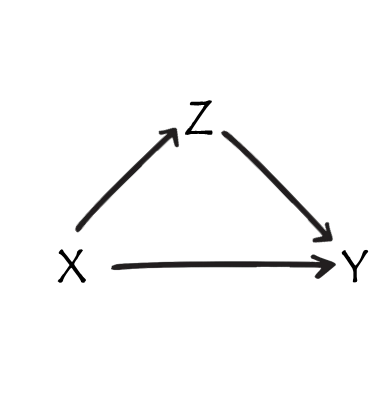
Z is a mediator
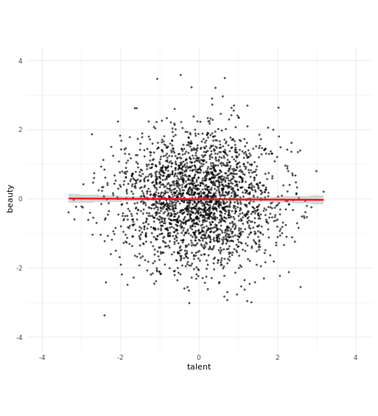
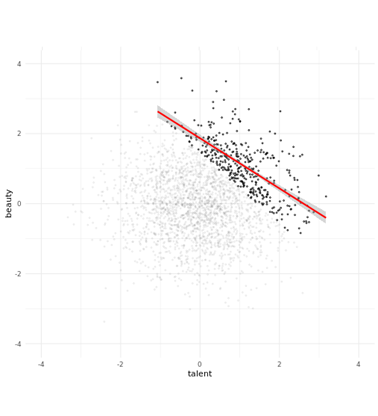
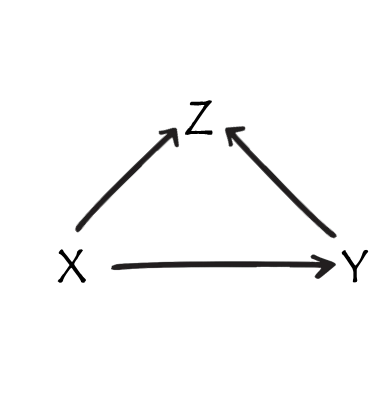
Z is a collider
example
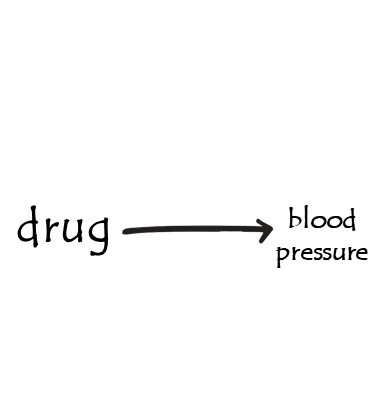
example
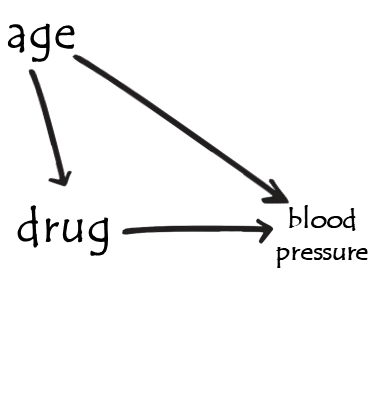
example
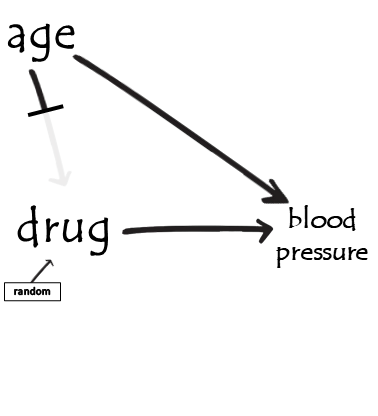
example
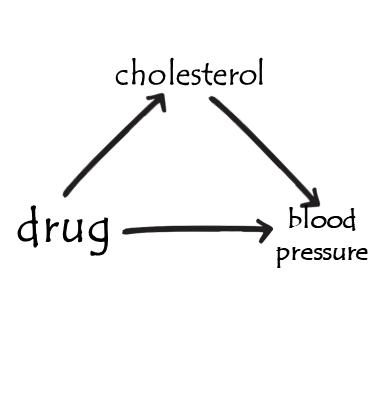
example 2
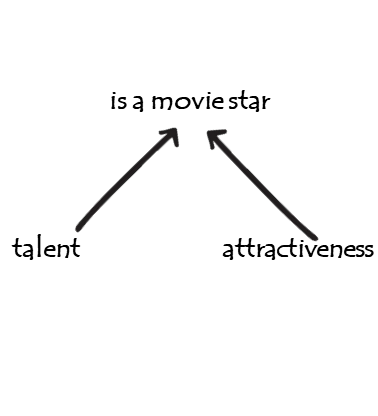
example 2

example 2

general heuristics (NOT rules)

  • control for a confounder

  • don’t control for a mediator

  • don’t control for a collider

  • draw your theoretical model before you get your data, so that you know what variables you (ideally) need.

More variance explained?

More than one predictor?

\(\color{red}{y} = \color{blue}{b_0 \cdot{} 1 + b_1 \cdot{} x_1 + \, ... \, + b_k \cdot x_k} + \varepsilon\)

mymodel <- lm(y ~ 1 + x1 + ... + xk, data = mydata)
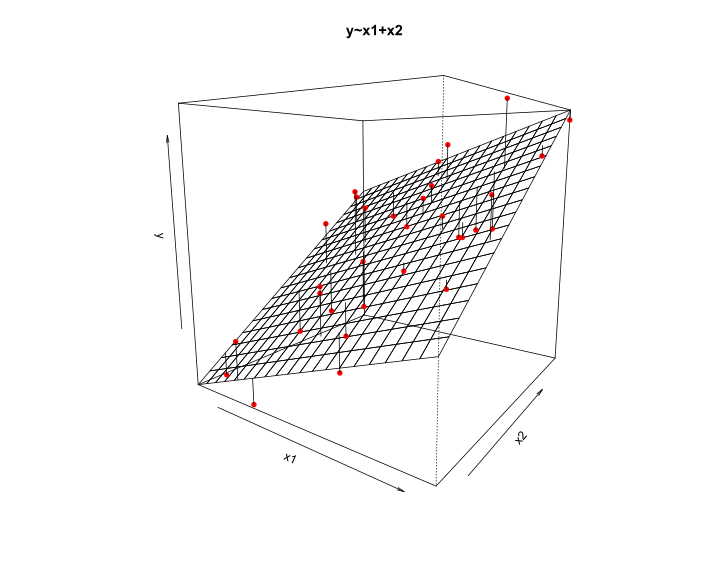
Model comparison

  • does x2 explain more variability in y than we would expect by a random variable, over and above variability explained by x1?

    • once we know x1, does knowing about x2 tell us anything new about y?
m1 <- lm(y ~ x1, data = mydata)
m2 <- lm(y ~ x1 + x2, data = mydata)

anova(m1, m2)
Analysis of Variance Table

Model 1: y ~ x1
Model 2: y ~ x1 + x2
  Res.Df   RSS Df Sum of Sq    F Pr(>F)   
1     98 13461                            
2     97 12121  1      1340 10.7 0.0015 **
---
Signif. codes:  0 '***' 0.001 '**' 0.01 '*' 0.05 '.' 0.1 ' ' 1

tests of multiple parameters

Model comparisons:

m1 <- lm(y ~ 1 + x, data = df)
m2 <- lm(y ~ 1 + z + z2 + x, data = df)
tests of multiple parameters (2)

isolate the improvement in model fit due to inclusion of additional parameters

m1 <- lm(y ~ 1 + x, data = df)
m2 <- lm(y ~ 1 + z + z2 + x, data = df)
anova(m1, m2)
Analysis of Variance Table

Model 1: y ~ 1 + x
Model 2: y ~ 1 + z + z2 + x
  Res.Df  RSS Df Sum of Sq   F Pr(>F)    
1     98 1141                            
2     96  357  2       785 106 <2e-16 ***
---
Signif. codes:  0 '***' 0.001 '**' 0.01 '*' 0.05 '.' 0.1 ' ' 1
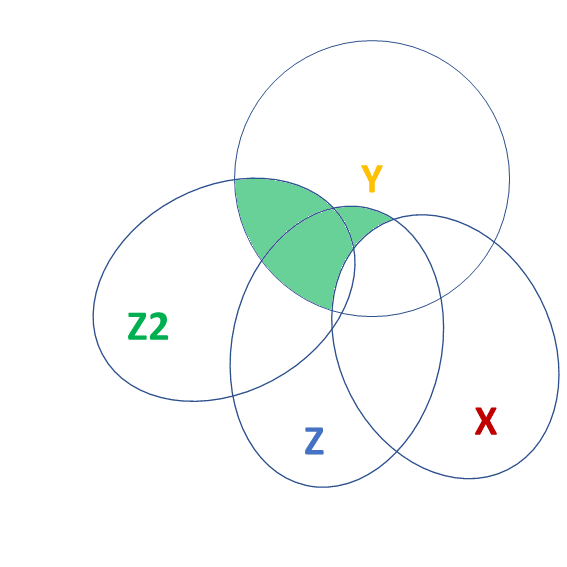
tests of multiple parameters (3)

Test everything in the model all at once by comparing it to a ‘null model’ with no predictors:

m0 <- lm(y ~ 1, data = df)
m2 <- lm(y ~ 1 + z2 + z + x, data = df)

anova(m0, m2)
Analysis of Variance Table

Model 1: y ~ 1
Model 2: y ~ 1 + z2 + z + x
  Res.Df  RSS Df Sum of Sq    F Pr(>F)    
1     99 1232                             
2     96  357  3       875 78.6 <2e-16 ***
---
Signif. codes:  0 '***' 0.001 '**' 0.01 '*' 0.05 '.' 0.1 ' ' 1
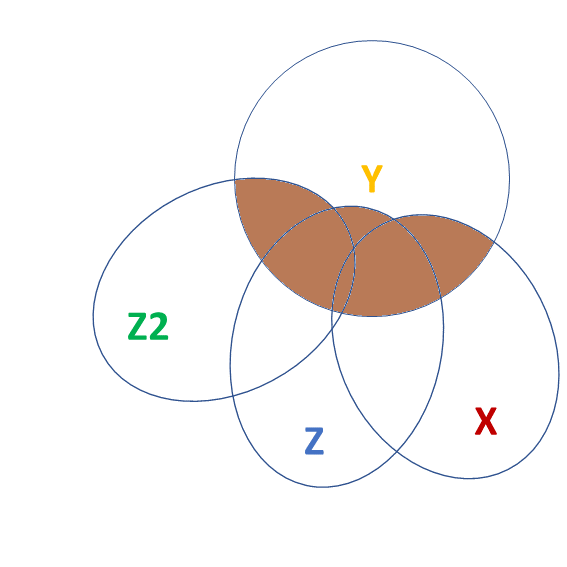
Coefficients

multiple regression model

\(\color{red}{y} = \color{blue}{b_0 \cdot{} 1 + b_1 \cdot{} x_1 + \, ... \, + b_k \cdot x_k} + \varepsilon\)

mymodel <- lm(y ~ 1 + x1 + ... + xk, data = mydata)
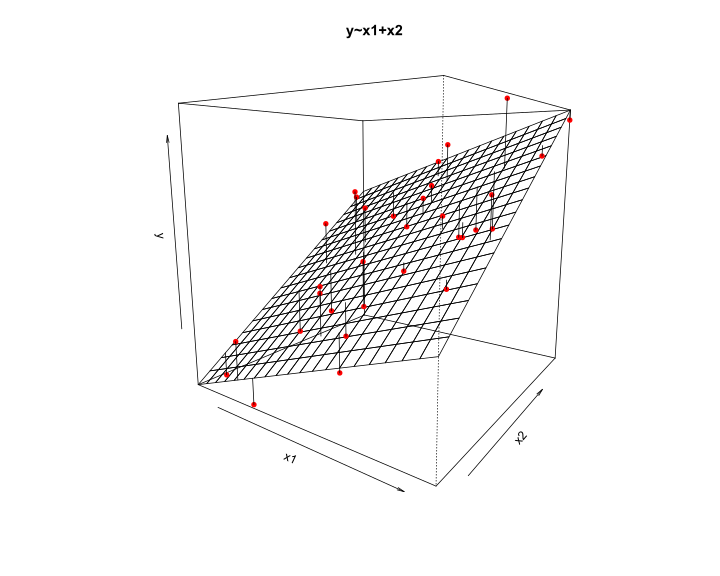
multiple regression coefficients

mod1 <- lm(y ~ x1 + x2, data = mydata)
summary(mod1)

Call:
lm(formula = y ~ x1 + x2, data = mydata)

Residuals:
   Min     1Q Median     3Q    Max 
-28.85  -6.27  -0.19   6.97  26.05 

Coefficients:
            Estimate Std. Error t value Pr(>|t|)    
(Intercept)   20.372      1.124   18.12   <2e-16 ***
x1             1.884      1.295    1.46   0.1488    
x2             2.042      0.624    3.28   0.0015 ** 
---
Signif. codes:  0 '***' 0.001 '**' 0.01 '*' 0.05 '.' 0.1 ' ' 1

Residual standard error: 11.2 on 97 degrees of freedom
Multiple R-squared:  0.135, Adjusted R-squared:  0.118 
F-statistic:  7.6 on 2 and 97 DF,  p-value: 0.00086


term est interpretation
(Intercept) 20.37 estimated y when all predictors are zero/reference level
x1 1.88 estimated change in y when x1 increases by 1, and all other predictors are held constant
x2 2.04 estimated change in y when x2 increases by 1, and all other predictors are held constant

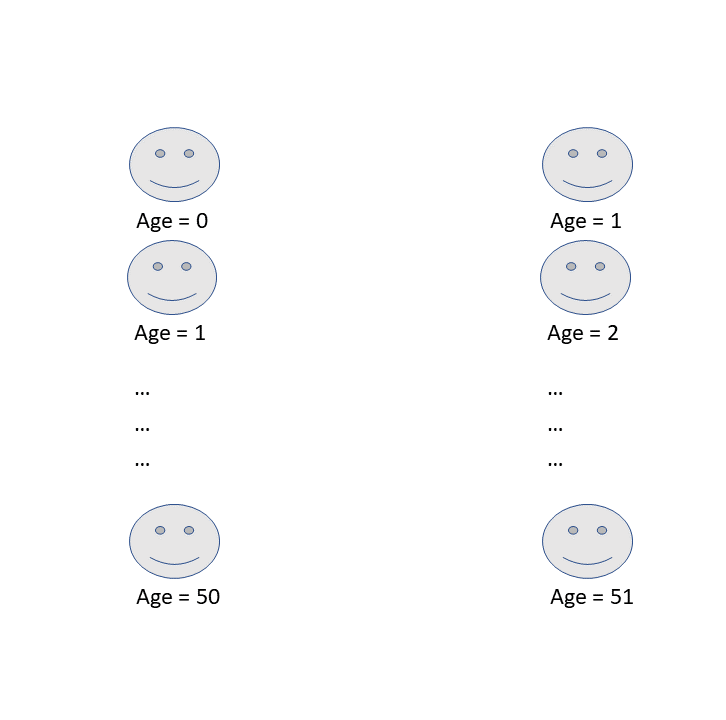
change in Y for a 1 unit change in X

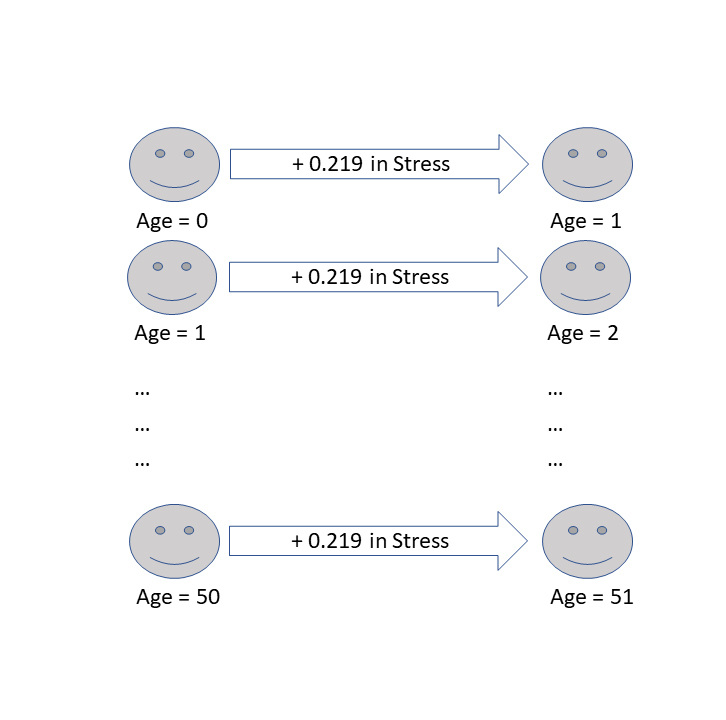
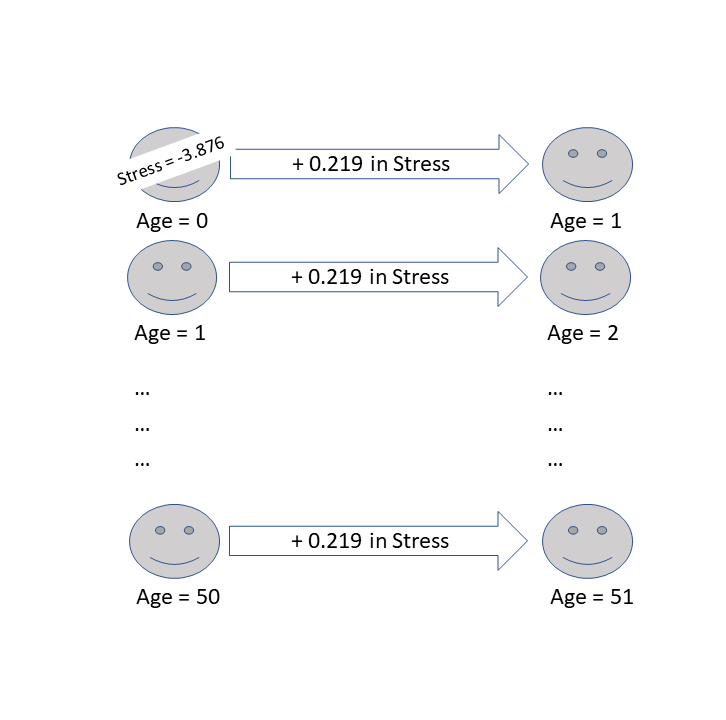
mod = lm(stress ~ age, data = df)
summary(mod)
Coefficients:
            Estimate Std. Error t value Pr(>|t|)   
(Intercept)  -3.8755     2.3911   -1.62   0.1437   
age           0.2187     0.0633    3.46   0.0086 **
---
Signif. codes:  0 '***' 0.001 '**' 0.01 '*' 0.05 '.' 0.1 ' ' 1

Residual standard error: 3.08 on 8 degrees of freedom
Multiple R-squared:  0.599, Adjusted R-squared:  0.549 
F-statistic: 11.9 on 1 and 8 DF,  p-value: 0.00862
unit level predictions

mod = lm(stress ~ age, data = df)
coef(mod)
(Intercept)         age 
     -3.875       0.219 

Data

# A tibble: 10 × 4
     age exercise therapy  stress
   <dbl>    <dbl>   <dbl>   <dbl>
 1    18        6       0  0.958 
 2    19        6       0  0.0447
 3    20        4       1 -1.81  
 4    33        5       0  7.60  
 5    67        3       1  7.53  
 6    24        1       1  1.61  
 7    37        7       0  6.03  
 8    55        6       0 12.6   
 9    41        4       1  2.60  
10    31        5       1 -0.500 

Predictions

# A tibble: 10 × 1
   prediction
        <dbl>
 1     0.0615
 2     0.280 
 3     0.499 
 4     3.34  
 5    10.8   
 6     1.37  
 7     4.22  
 8     8.15  
 9     5.09  
10     2.90  

unit level counterfactuals

mod = lm(stress ~ age, data = df)
coef(mod)
(Intercept)         age 
     -3.875       0.219 

Data

# A tibble: 10 × 4
     age exercise therapy  stress
   <dbl>    <dbl>   <dbl>   <dbl>
 1    18        6       0  0.958 
 2    19        6       0  0.0447
 3    20        4       1 -1.81  
 4    33        5       0  7.60  
 5    67        3       1  7.53  
 6    24        1       1  1.61  
 7    37        7       0  6.03  
 8    55        6       0 12.6   
 9    41        4       1  2.60  
10    31        5       1 -0.500 

Predictions

# A tibble: 10 × 1
   prediction
        <dbl>
 1     0.0615
 2     0.280 
 3     0.499 
 4     3.34  
 5    10.8   
 6     1.37  
 7     4.22  
 8     8.15  
 9     5.09  
10     2.90  

Counterfactuals

# A tibble: 10 × 3
   counterfactual_age prediction  diff
                <dbl>      <dbl> <dbl>
 1                 19      0.280 0.219
 2                 20      0.499 0.219
 3                 21      0.718 0.219
 4                 34      3.56  0.219
 5                 68     11.0   0.219
 6                 25      1.59  0.219
 7                 38      4.44  0.219
 8                 56      8.37  0.219
 9                 42      5.31  0.219
10                 32      3.12  0.219

unit level counterfactuals

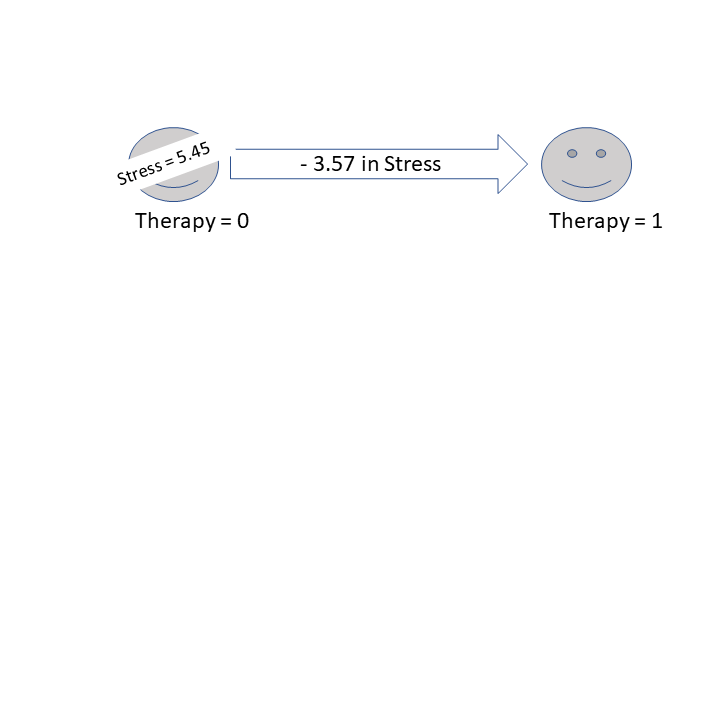
mod = lm(stress ~ therapy, data = df)
coef(mod)
(Intercept)     therapy 
       5.45       -3.57 

Data

# A tibble: 10 × 4
     age exercise therapy  stress
   <dbl>    <dbl>   <dbl>   <dbl>
 1    18        6       0  0.958 
 2    19        6       0  0.0447
 3    20        4       1 -1.81  
 4    33        5       0  7.60  
 5    67        3       1  7.53  
 6    24        1       1  1.61  
 7    37        7       0  6.03  
 8    55        6       0 12.6   
 9    41        4       1  2.60  
10    31        5       1 -0.500 

Predictions

# A tibble: 10 × 1
   prediction
        <dbl>
 1       5.45
 2       5.45
 3       1.89
 4       5.45
 5       1.89
 6       1.89
 7       5.45
 8       5.45
 9       1.89
10       1.89

Counterfactuals

# A tibble: 10 × 3
   counterfactual_therapy prediction  diff
                    <dbl>      <dbl> <dbl>
 1                      1       1.89 -3.57
 2                      1       1.89 -3.57
 3                      0       5.45  3.57
 4                      1       1.89 -3.57
 5                      0       5.45  3.57
 6                      0       5.45  3.57
 7                      1       1.89 -3.57
 8                      1       1.89 -3.57
 9                      0       5.45  3.57
10                      0       5.45  3.57

holding constant

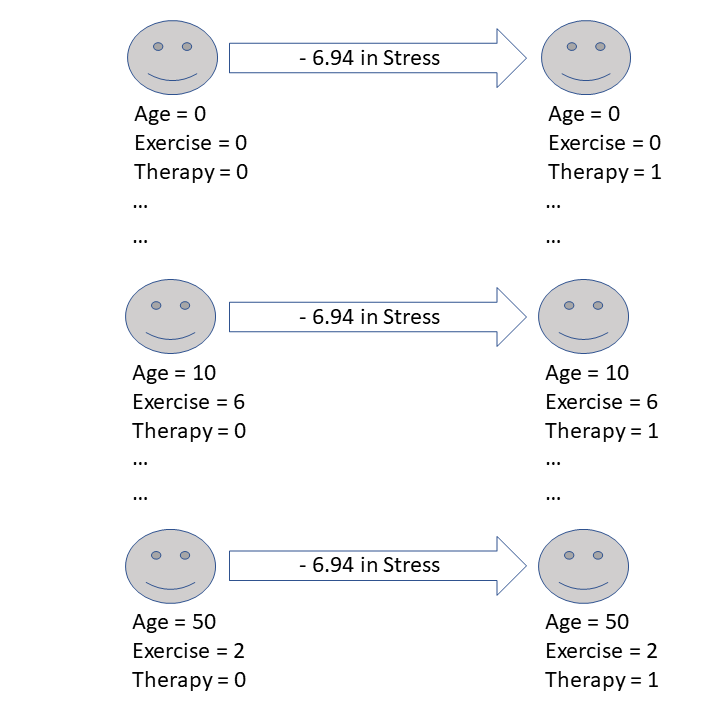
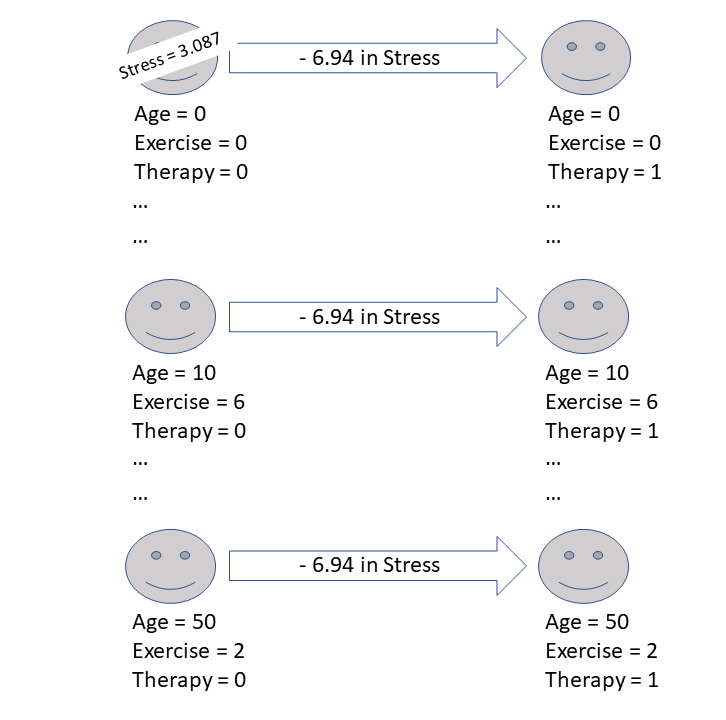
mod = lm(stress ~ age + exercise + therapy, data = df)
coef(mod)
(Intercept)         age    exercise     therapy 
      3.087       0.241      -0.908      -6.940 

Data

# A tibble: 10 × 4
     age exercise therapy  stress
   <dbl>    <dbl>   <dbl>   <dbl>
 1    18        6       0  0.958 
 2    19        6       0  0.0447
 3    20        4       1 -1.81  
 4    33        5       0  7.60  
 5    67        3       1  7.53  
 6    24        1       1  1.61  
 7    37        7       0  6.03  
 8    55        6       0 12.6   
 9    41        4       1  2.60  
10    31        5       1 -0.500 

Predictions

# A tibble: 10 × 1
   prediction
        <dbl>
 1      1.98 
 2      2.22 
 3     -2.66 
 4      6.51 
 5      9.58 
 6      1.03 
 7      5.65 
 8     10.9  
 9      2.40 
10     -0.916

Counterfactuals

# A tibble: 10 × 5
     age exercise counterfactual_therapy prediction  diff
   <dbl>    <dbl>                  <dbl>      <dbl> <dbl>
 1    18        6                      1     -4.96  -6.94
 2    19        6                      1     -4.72  -6.94
 3    20        4                      0      4.28   6.94
 4    33        5                      1     -0.434 -6.94
 5    67        3                      0     16.5    6.94
 6    24        1                      0      7.97   6.94
 7    37        7                      1     -1.29  -6.94
 8    55        6                      1      3.96  -6.94
 9    41        4                      0      9.34   6.94
10    31        5                      0      6.02   6.94

Think in hypotheticals

mod = lm(stress ~ age, data = df)
summary(mod)
Coefficients:
            Estimate Std. Error t value Pr(>|t|)   
(Intercept)  -3.8755     2.3911   -1.62   0.1437   
age           0.2187     0.0633    3.46   0.0086 **
---
Signif. codes:  0 '***' 0.001 '**' 0.01 '*' 0.05 '.' 0.1 ' ' 1

Residual standard error: 3.08 on 8 degrees of freedom
Multiple R-squared:  0.599, Adjusted R-squared:  0.549 
F-statistic: 11.9 on 1 and 8 DF,  p-value: 0.00862
Think in hypotheticals

mod = lm(stress ~ age, data = df)
summary(mod)
Coefficients:
            Estimate Std. Error t value Pr(>|t|)   
(Intercept)  -3.8755     2.3911   -1.62   0.1437   
age           0.2187     0.0633    3.46   0.0086 **
---
Signif. codes:  0 '***' 0.001 '**' 0.01 '*' 0.05 '.' 0.1 ' ' 1

Residual standard error: 3.08 on 8 degrees of freedom
Multiple R-squared:  0.599, Adjusted R-squared:  0.549 
F-statistic: 11.9 on 1 and 8 DF,  p-value: 0.00862
Think in hypotheticals

mod = lm(stress ~ age, data = df)
summary(mod)
Coefficients:
            Estimate Std. Error t value Pr(>|t|)   
(Intercept)  -3.8755     2.3911   -1.62   0.1437   
age           0.2187     0.0633    3.46   0.0086 **
---
Signif. codes:  0 '***' 0.001 '**' 0.01 '*' 0.05 '.' 0.1 ' ' 1

Residual standard error: 3.08 on 8 degrees of freedom
Multiple R-squared:  0.599, Adjusted R-squared:  0.549 
F-statistic: 11.9 on 1 and 8 DF,  p-value: 0.00862

Think in hypotheticals

mod = lm(stress ~ therapy, data = df)
summary(mod)
Coefficients:
            Estimate Std. Error t value Pr(>|t|)  
(Intercept)     5.45       1.99    2.75    0.025 *
therapy        -3.57       2.81   -1.27    0.240  
---
Signif. codes:  0 '***' 0.001 '**' 0.01 '*' 0.05 '.' 0.1 ' ' 1

Residual standard error: 4.44 on 8 degrees of freedom
Multiple R-squared:  0.168, Adjusted R-squared:  0.0637 
F-statistic: 1.61 on 1 and 8 DF,  p-value: 0.24
Think in hypotheticals

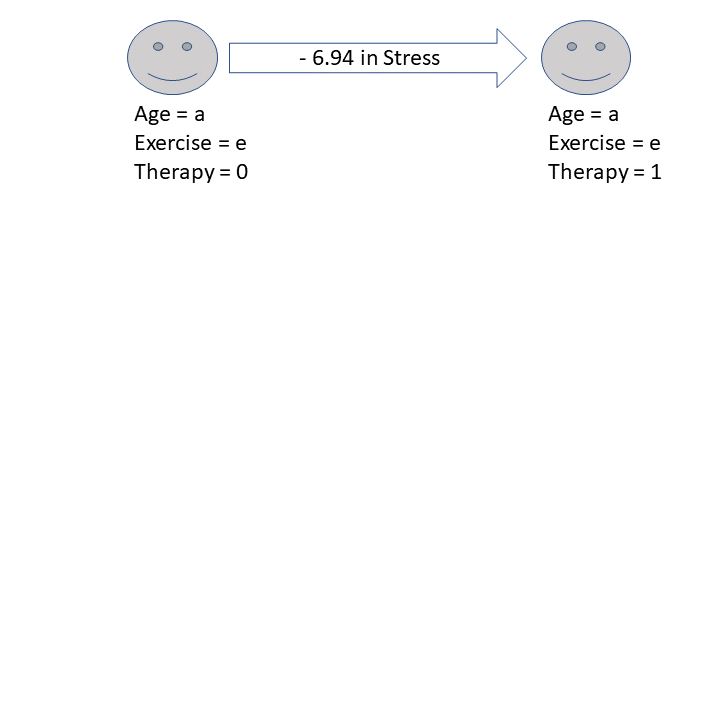
mod = lm(stress ~ age + exercise + therapy, data = df)
summary(mod)
Coefficients:
            Estimate Std. Error t value Pr(>|t|)    
(Intercept)   3.0874     3.1338    0.99  0.36259    
age           0.2412     0.0334    7.22  0.00036 ***
exercise     -0.9082     0.4817   -1.89  0.10836    
therapy      -6.9398     1.6246   -4.27  0.00525 ** 
---
Signif. codes:  0 '***' 0.001 '**' 0.01 '*' 0.05 '.' 0.1 ' ' 1

Residual standard error: 1.61 on 6 degrees of freedom
Multiple R-squared:  0.918, Adjusted R-squared:  0.877 
F-statistic: 22.3 on 3 and 6 DF,  p-value: 0.00118
Think in hypotheticals

mod = lm(stress ~ age + exercise + therapy, data = df)
summary(mod)
Coefficients:
            Estimate Std. Error t value Pr(>|t|)    
(Intercept)   3.0874     3.1338    0.99  0.36259    
age           0.2412     0.0334    7.22  0.00036 ***
exercise     -0.9082     0.4817   -1.89  0.10836    
therapy      -6.9398     1.6246   -4.27  0.00525 ** 
---
Signif. codes:  0 '***' 0.001 '**' 0.01 '*' 0.05 '.' 0.1 ' ' 1

Residual standard error: 1.61 on 6 degrees of freedom
Multiple R-squared:  0.918, Adjusted R-squared:  0.877 
F-statistic: 22.3 on 3 and 6 DF,  p-value: 0.00118
Think in hypotheticals

mod = lm(stress ~ age + exercise + therapy, data = df)
summary(mod)
Coefficients:
            Estimate Std. Error t value Pr(>|t|)    
(Intercept)   3.0874     3.1338    0.99  0.36259    
age           0.2412     0.0334    7.22  0.00036 ***
exercise     -0.9082     0.4817   -1.89  0.10836    
therapy      -6.9398     1.6246   -4.27  0.00525 ** 
---
Signif. codes:  0 '***' 0.001 '**' 0.01 '*' 0.05 '.' 0.1 ' ' 1

Residual standard error: 1.61 on 6 degrees of freedom
Multiple R-squared:  0.918, Adjusted R-squared:  0.877 
F-statistic: 22.3 on 3 and 6 DF,  p-value: 0.00118
categorical predictors

example - simple regression

head(braindata)
# A tibble: 6 × 4
  species       mass_brain   age isMonkey
  <chr>              <dbl> <dbl> <chr>   
1 Rhesus monkey      0.449     5 YES     
2 Human              0.577     2 NO      
3 Potar monkey       0.349    30 YES     
4 Human              0.626    27 NO      
5 Potar monkey       0.316    31 YES     
6 Rhesus monkey      0.398    11 YES     
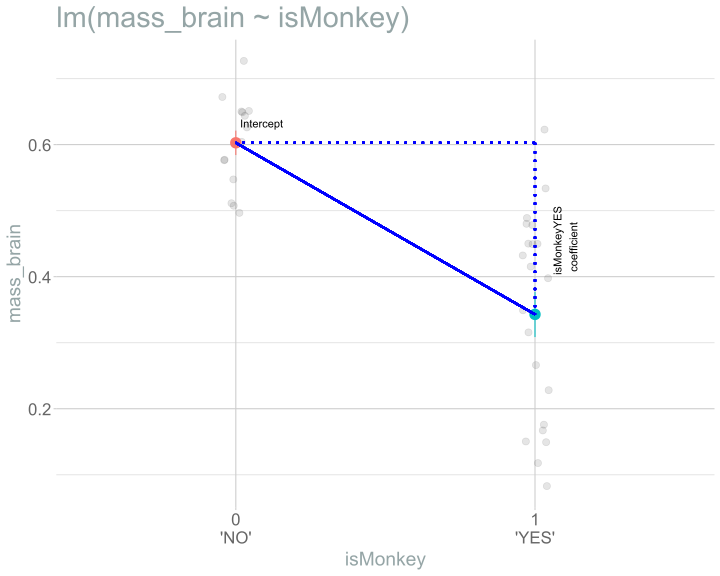
monkmod <- lm(mass_brain~isMonkey, data = braindata)
summary(monkmod)
Coefficients:
            Estimate Std. Error t value  Pr(>|t|)    
(Intercept)   0.6027     0.0347   17.35   < 2e-16 ***
isMonkeyYES  -0.2599     0.0449   -5.79 0.0000018 ***
  • (Intercept): the estimated brain mass of Humans (when the isMonkeyYES variable is zero)
  • isMonkeyYES: the estimated change in brain mass from Humans to Monkeys (change in brain mass when moving from isMonkeyYES = 0 to isMonkeyYES = 1).

example - simple regression

head(braindata)
# A tibble: 6 × 4
  species       mass_brain   age isMonkey
  <chr>              <dbl> <dbl> <chr>   
1 Rhesus monkey      0.449     5 YES     
2 Human              0.577     2 NO      
3 Potar monkey       0.349    30 YES     
4 Human              0.626    27 NO      
5 Potar monkey       0.316    31 YES     
6 Rhesus monkey      0.398    11 YES     
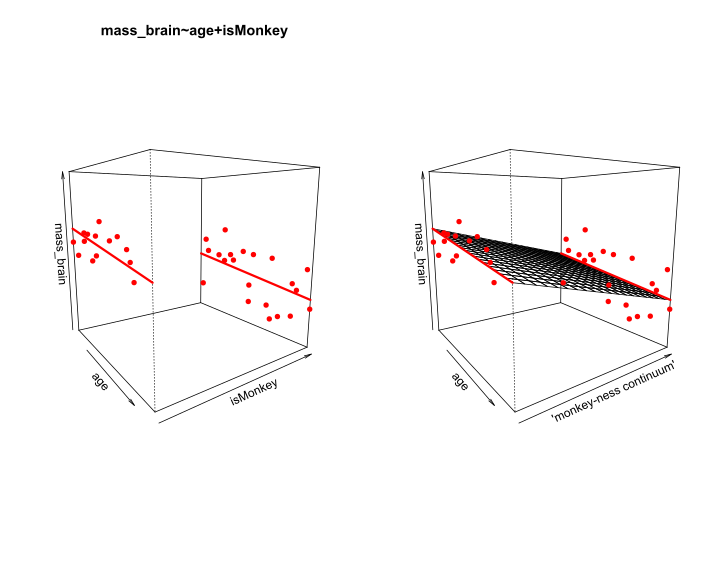
Figure 1: A binary categorical predictor

example - in multiple regression

head(braindata)
# A tibble: 6 × 4
  species       mass_brain   age isMonkey
  <chr>              <dbl> <dbl> <chr>   
1 Rhesus monkey      0.449     5 YES     
2 Human              0.577     2 NO      
3 Potar monkey       0.349    30 YES     
4 Human              0.626    27 NO      
5 Potar monkey       0.316    31 YES     
6 Rhesus monkey      0.398    11 YES     
monkmod2 <- lm(mass_brain~age + isMonkey, data = braindata)
summary(monkmod2)
Coefficients:
            Estimate Std. Error t value Pr(>|t|)    
(Intercept)  0.66831    0.05048   13.24  1.6e-14 ***
age         -0.00408    0.00234   -1.75     0.09 .  
isMonkeyYES -0.24693    0.04415   -5.59  3.5e-06 ***
  • (Intercept): the estimated brain mass of new-born Humans (when both age is zero and isMonkeyYES is zero)
  • age: the estimated change in brain mass for every 1 year increase in age, holding isMonkey constant.
  • isMonkeyYES: the estimated change in brain mass from Humans to Monkeys (change in brain mass when moving from isMonkeyYES = 0 to isMonkeyYES = 1), holding age constant.

example - in multiple regression

head(braindata)
# A tibble: 6 × 4
  species       mass_brain   age isMonkey
  <chr>              <dbl> <dbl> <chr>   
1 Rhesus monkey      0.449     5 YES     
2 Human              0.577     2 NO      
3 Potar monkey       0.349    30 YES     
4 Human              0.626    27 NO      
5 Potar monkey       0.316    31 YES     
6 Rhesus monkey      0.398    11 YES     
Figure 2: a binary predictor is just another dimension, but data can only exist at either 0 or 1. If a variable were continuous, then observations can take any value along a line

example - multiple levels

braindata <- braindata %>% mutate(
  speciesPotar = ifelse(species == "Potar monkey", 1, 0),
  speciesRhesus = ifelse(species == "Rhesus monkey", 1, 0),
)
braindata %>% 
  select(mass_brain, species, speciesPotar, speciesRhesus) %>%
  head()
# A tibble: 6 × 4
  mass_brain species       speciesPotar speciesRhesus
       <dbl> <chr>                <dbl>         <dbl>
1      0.449 Rhesus monkey            0             1
2      0.577 Human                    0             0
3      0.349 Potar monkey             1             0
4      0.626 Human                    0             0
5      0.316 Potar monkey             1             0
6      0.398 Rhesus monkey            0             1
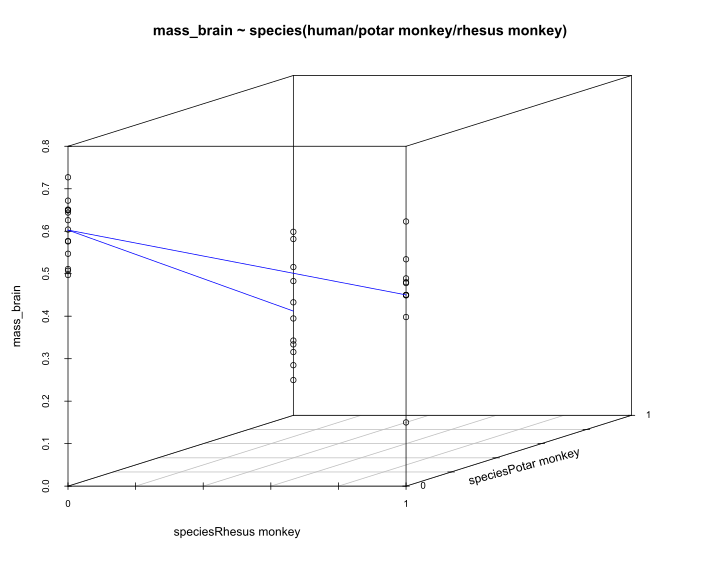
  • For a human, both speciesPotar == 0 and speciesRhesus == 0
  • For a Potar monkey, speciesPotar == 1 and speciesRhesus == 0
  • For a Rhesus monkey, speciesPotar == 0 and speciesRhesus == 1

example - multiple levels

lm(mass_brain ~ species, data = braindata) |> 
  summary()

Call:
lm(formula = mass_brain ~ species, data = braindata)

Residuals:
     Min       1Q   Median       3Q      Max 
-0.30010 -0.06254  0.00129  0.04779  0.18664 

Coefficients:
                     Estimate Std. Error t value Pr(>|t|)    
(Intercept)            0.6027     0.0275   21.94  < 2e-16 ***
speciesPotar monkey   -0.3574     0.0414   -8.63  7.4e-10 ***
speciesRhesus monkey  -0.1526     0.0426   -3.59   0.0011 ** 
---
Signif. codes:  0 '***' 0.001 '**' 0.01 '*' 0.05 '.' 0.1 ' ' 1

Residual standard error: 0.103 on 32 degrees of freedom
Multiple R-squared:  0.699, Adjusted R-squared:  0.681 
F-statistic: 37.2 on 2 and 32 DF,  p-value: 4.45e-09
lm(mass_brain ~ speciesPotar + speciesRhesus, data = braindata) |> 
  summary()

Call:
lm(formula = mass_brain ~ speciesPotar + speciesRhesus, data = braindata)

Residuals:
     Min       1Q   Median       3Q      Max 
-0.30010 -0.06254  0.00129  0.04779  0.18664 

Coefficients:
              Estimate Std. Error t value Pr(>|t|)    
(Intercept)     0.6027     0.0275   21.94  < 2e-16 ***
speciesPotar   -0.3574     0.0414   -8.63  7.4e-10 ***
speciesRhesus  -0.1526     0.0426   -3.59   0.0011 ** 
---
Signif. codes:  0 '***' 0.001 '**' 0.01 '*' 0.05 '.' 0.1 ' ' 1

Residual standard error: 0.103 on 32 degrees of freedom
Multiple R-squared:  0.699, Adjusted R-squared:  0.681 
F-statistic: 37.2 on 2 and 32 DF,  p-value: 4.45e-09

example - multiple levels

more levels = more dimensions
example - multiple levels

lm(mass_brain ~ species, data = braindata) |> 
  summary()

Call:
lm(formula = mass_brain ~ species, data = braindata)

Residuals:
     Min       1Q   Median       3Q      Max 
-0.30010 -0.06254  0.00129  0.04779  0.18664 

Coefficients:
                     Estimate Std. Error t value Pr(>|t|)    
(Intercept)            0.6027     0.0275   21.94  < 2e-16 ***
speciesPotar monkey   -0.3574     0.0414   -8.63  7.4e-10 ***
speciesRhesus monkey  -0.1526     0.0426   -3.59   0.0011 ** 
---
Signif. codes:  0 '***' 0.001 '**' 0.01 '*' 0.05 '.' 0.1 ' ' 1

Residual standard error: 0.103 on 32 degrees of freedom
Multiple R-squared:  0.699, Adjusted R-squared:  0.681 
F-statistic: 37.2 on 2 and 32 DF,  p-value: 4.45e-09
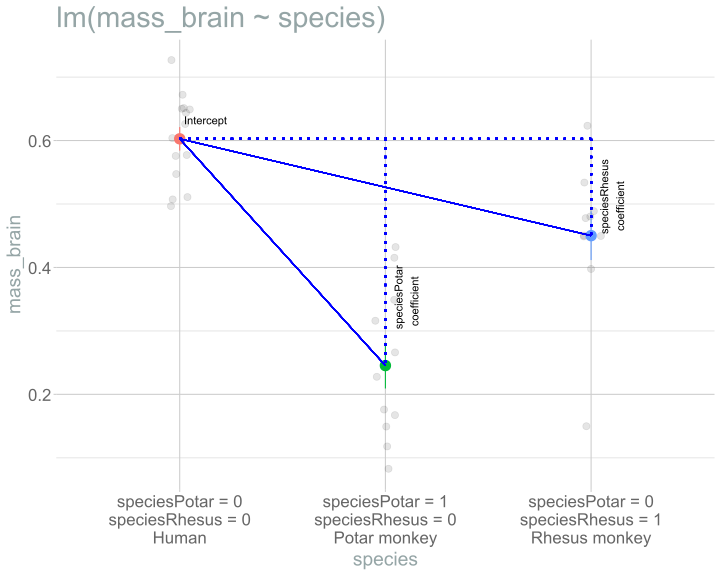
Figure 3: A categorical predictor with 3 levels

Thanks all!