Confirmatory Factor Analysis (CFA)

Data Analysis for Psychology in R 3

Dr Josiah King

Psychology, PPLS

University of Edinburgh

Course Overview

multilevel modelling
working with group structured data
regression refresher
the multilevel model
more complex groupings
centering, assumptions, and diagnostics
recap
factor analysis
working with multi-item measures
measurement and dimensionality
exploring underlying constructs (EFA)
testing theoretical models (CFA)
reliability and validity
recap & exam prep

Week 8 TR;DL

  • PCA just takes a set of observed variables and reduces.
    • we don’t really care what the components are, we don’t have a theory why variables are correlated
  • EFA is a model of underlying ‘latent variables/factors’ that give rise to responses on observed variables
    • we give a meaning to the underlying factors
  • The aim is to explore different models (e.g., 1 factor, 2 factor) to understand what our measurement tool captures
  • the “best” model here is a combination of
    • variance explained
    • “simple structure” (clear patterns of loadings)
    • theoretical coherence

This week

  • CFA vs EFA
  • CFA in R (lavaan)
  • Model fit
  • Model modification
  • the gateway to SEM

from EFA to CFA

What is your quest?

  • I have too many correlated variables. I just need to reduce → PCA

  • I want to understand the underlying structure of my set of correlated variables → EFA

  • I have a theoretical structure underlying a set of correlated variables. I want to test it → CFA

  • I need a way to get a single score for a construct → mean scores/sum scores/PCA/EFA/CFA

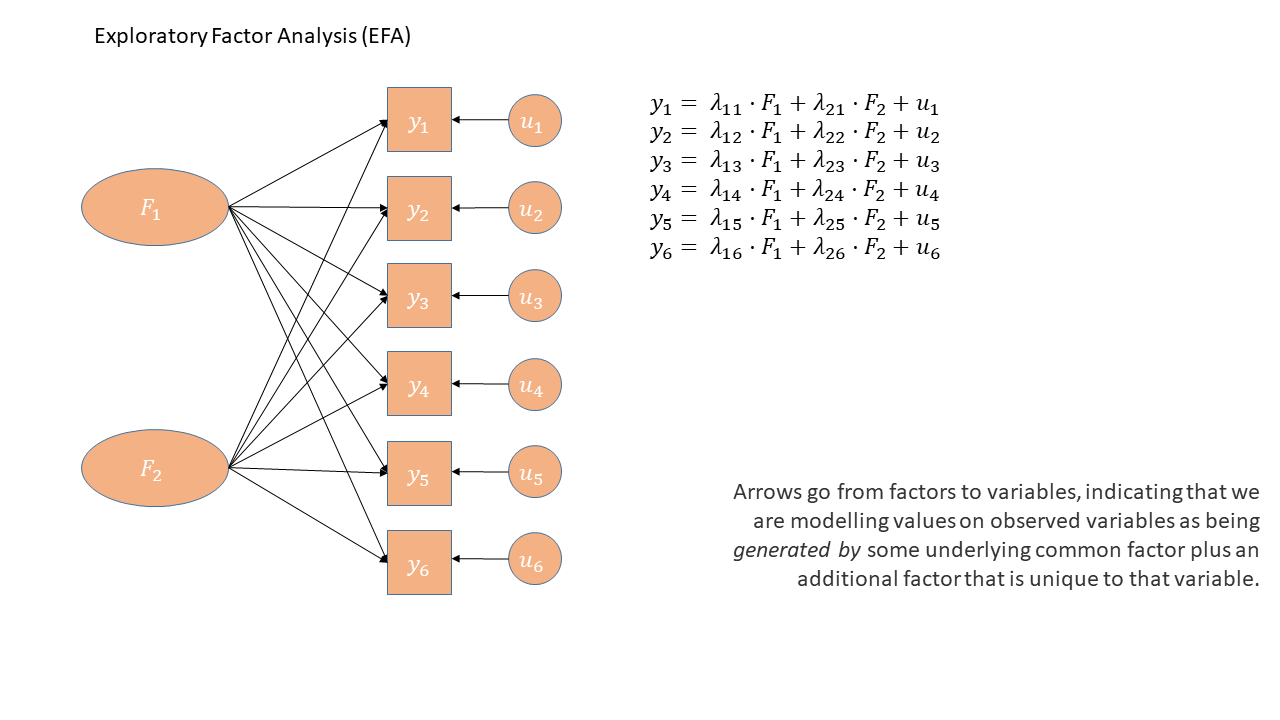
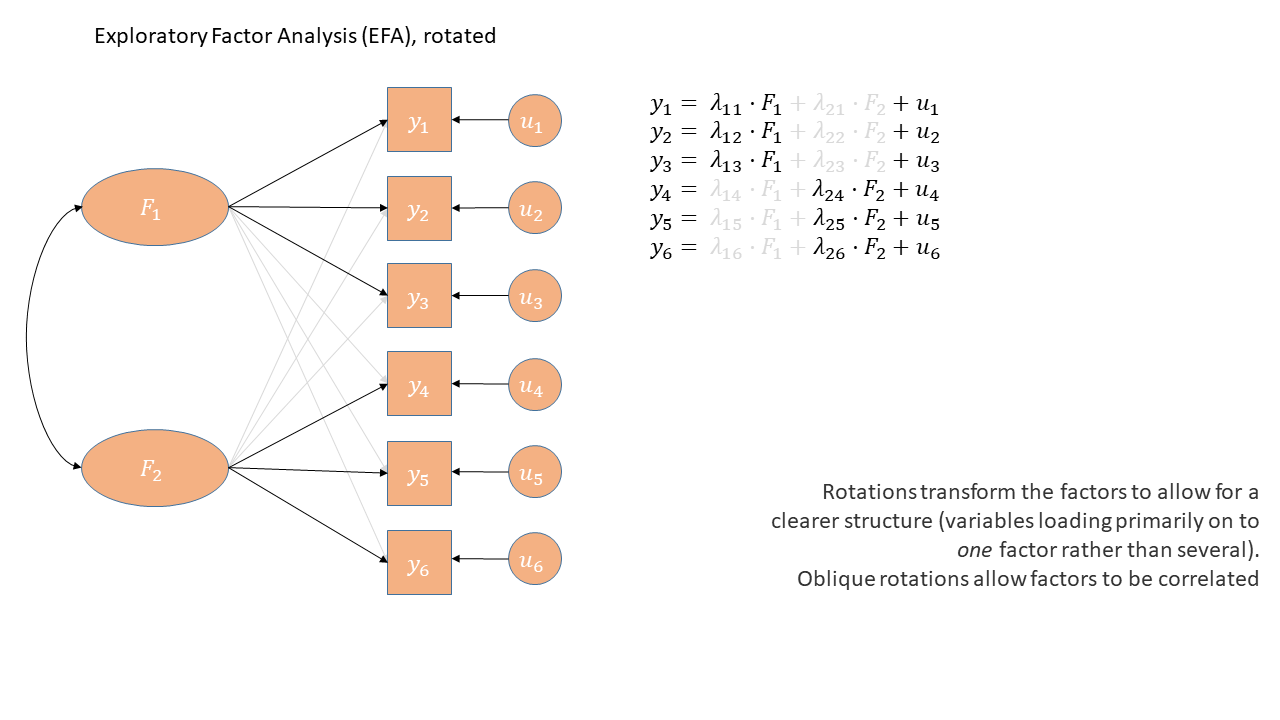
In diagrams: EFA

In diagrams: EFA (oblique rotation)
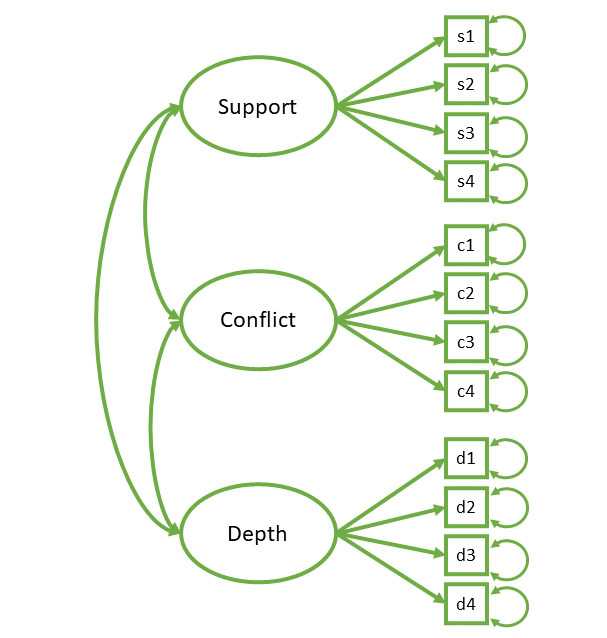
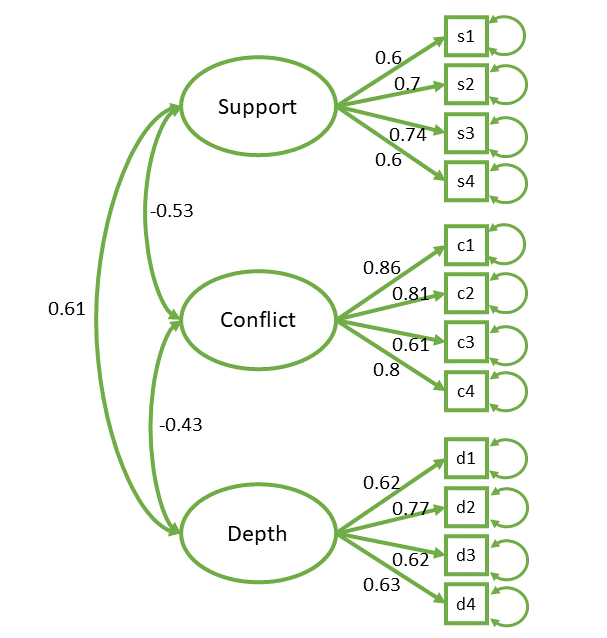
In diagrams: CFA
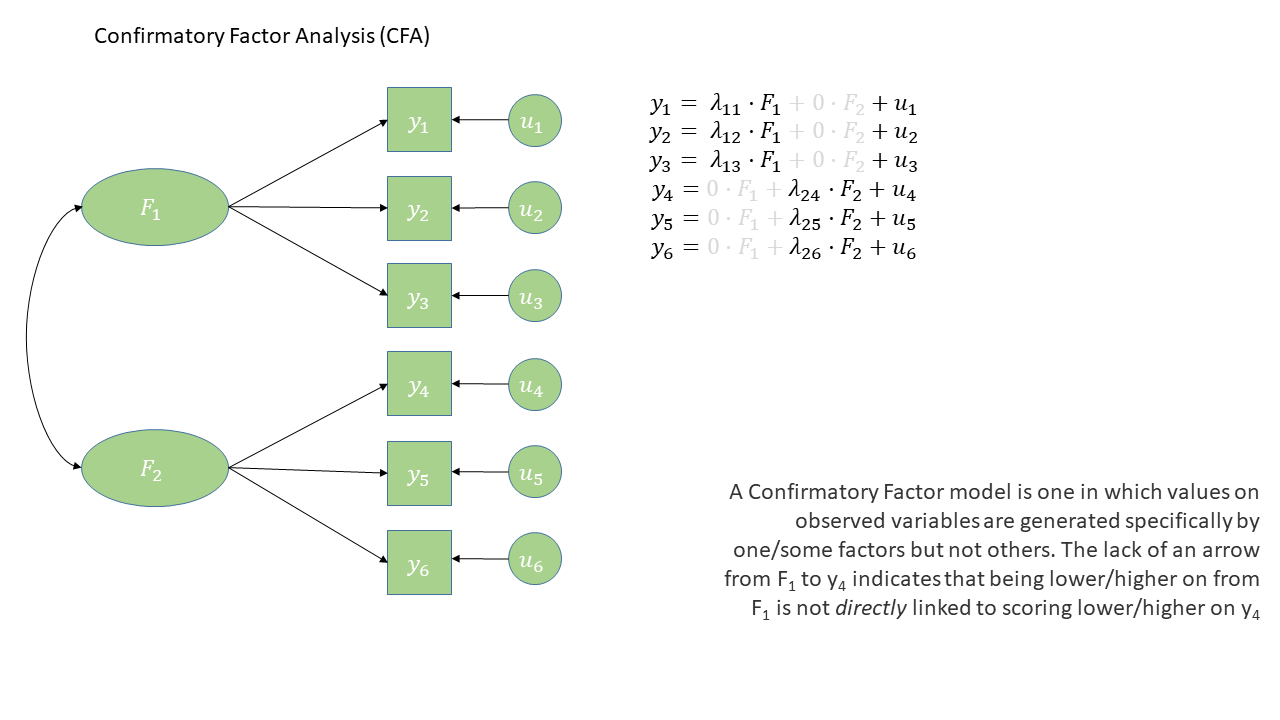
In diagrams: CFA
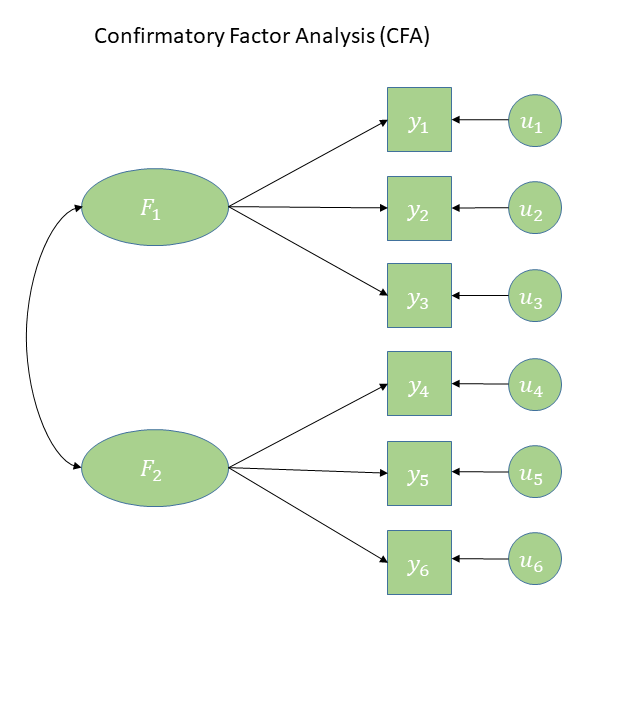
  • Some arrows are absent
  • This is what imposes our theory
  • The reason that \(y_1\) and \(y_2\) are correlated is because:
    • they both represent \(F_1\)
  • The reason that \(y_1\) and \(y_6\) are correlated is because:
    • \(y_1\) is a manifestation of \(F_1\),
    • \(y_6\) is a manifestation of \(F_2\),
    • and \(F_1\) and \(F_2\) are correlated

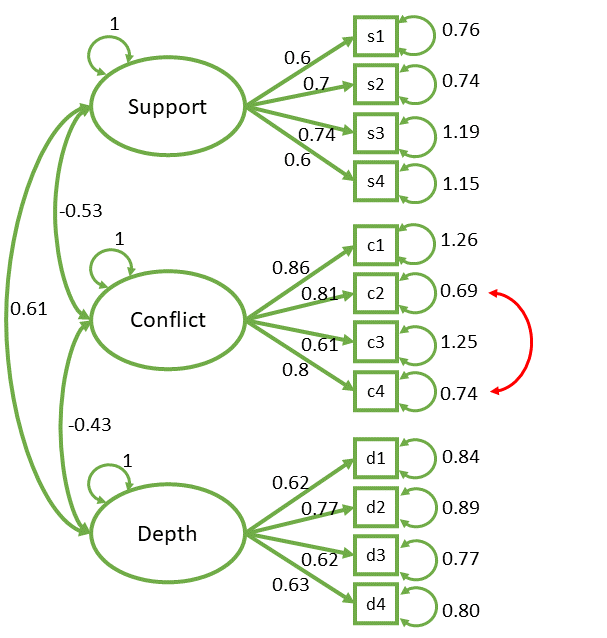
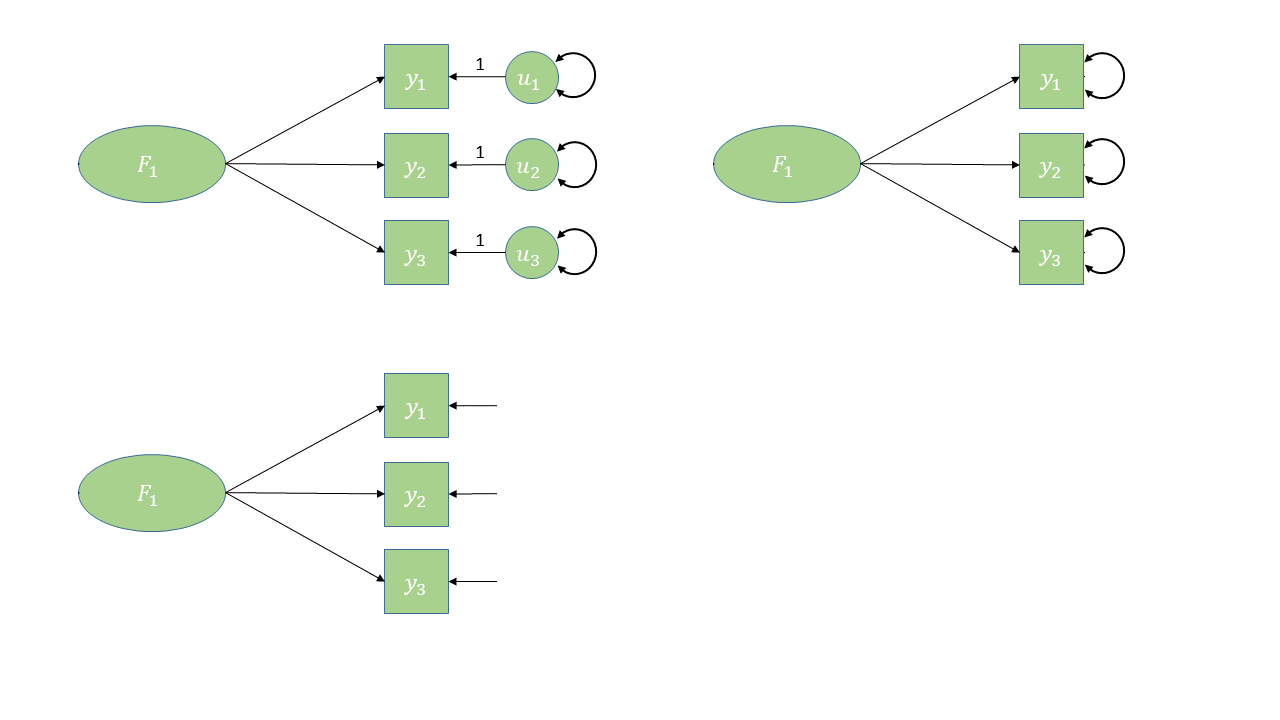
In diagrams: residuals in CFA

different ways people choose to draw the same thing…
CFA in R

The steps of CFA1

  1. measures, assumptions, data
  2. specification
  3. identification
  4. estimation
  5. fit
  6. possible respecification
  7. interpretation

the lavaan package

  • latent variable analysis”

  • general modelling framework that estimates models that may include latent variables

Typically done in 2 steps

Previously:

  • lm(formula, data = mydata)
  • glm(formula, data = mydata)
  • lmer(formula, data = mydata)

With {lavaan}:

  • Specify model formula in quotation marks:
    mymod <- "................"

  • Estimate1 formula with a fitting function such as:
    mymod.est <- cfa(mymod, data = mydata)

lavaan operators

Formula type Operator Mnemonic
latent variable definition =~ “is measured by”
(residual) (co)variance ~~ “covaries with”


F1 =~ y1 + y2 + y3
F2 =~ y4 + y5 + y6
F1 ~~ F2

example: QRI
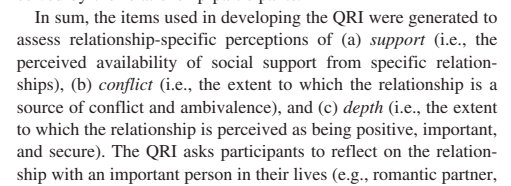
var wording
s1 To what extent could you turn to this person for advice about problems?
s2 To what extent could you count on this person for help with a problem?
s3 To what extent can you really count on this person to distract you from your worries when you feel under stress?
s4 To what extent can you count on this person to listen to you when you are very angry at someone else?
c1 How often do you have to work hard to avoid conflict with this person?
c2 How much do you argue with this person?
c3 How much would you like this person to change?
c4 How often does this person make you feel angry?
d1 How positive a role does this person play in your life?
d2 How significant is this relationship in your life?
d3 How close will your relationship be with this person in 10 years?
d4 How much would you miss this person if the two of you could not see or talk with each other for a month?

example: QRI

qri <- read.csv("https://uoepsy.github.io/data/qri.csv")
head(qri)
  s2 d4 c3 c4 d1 c2 s1 s4 d2 c1 s3 d3
1  4  4  5  5  5  4  3  3  2  3  5  5
2  3  5  4  4  2  4  4  5  2  4  4  4
3  4  5  4  5  4  2  5  3  6  2  4  5
4  3  6  4  3  5  3  3  4  4  2  5  5
5  6  7  1  2  4  2  7  7  4  1  7  5
6  3  5  5  4  4  3  5  4  3  3  5  5
mymod <- "
support =~ s1 + s2 + s3 + s4
conflict =~ c1 + c2 + c3 + c4
depth =~ d1 + d2 + d3 + d4

support ~~ conflict
support ~~ depth
conflict ~~ depth
"

mymod.est <- cfa(mymod, data = qri, std.lv = TRUE)

example: QRI

summary(mymod.est)
lavaan 0.6-19 ended normally after 19 iterations

  Estimator                                         ML
  Optimization method                           NLMINB
  Number of model parameters                        27

  Number of observations                           374

Model Test User Model:
                                                      
  Test statistic                                81.100
  Degrees of freedom                                51
  P-value (Chi-square)                           0.005

Parameter Estimates:

  Standard errors                             Standard
  Information                                 Expected
  Information saturated (h1) model          Structured

Latent Variables:
                   Estimate  Std.Err  z-value  P(>|z|)
  support =~                                          
    s1                0.601    0.062    9.765    0.000
    s2                0.707    0.064   11.010    0.000
    s3                0.642    0.074    8.676    0.000
    s4                0.608    0.072    8.407    0.000
  conflict =~                                         
    c1                0.860    0.077   11.102    0.000
    c2                0.810    0.063   12.909    0.000
    c3                0.614    0.072    8.532    0.000
    c4                0.808    0.064   12.673    0.000
  depth =~                                            
    d1                0.617    0.063    9.759    0.000
    d2                0.770    0.069   11.175    0.000
    d3                0.621    0.061   10.119    0.000
    d4                0.634    0.062   10.143    0.000

Covariances:
                   Estimate  Std.Err  z-value  P(>|z|)
  support ~~                                          
    conflict         -0.530    0.063   -8.473    0.000
    depth             0.613    0.062    9.956    0.000
  conflict ~~                                         
    depth            -0.425    0.065   -6.551    0.000

Variances:
                   Estimate  Std.Err  z-value  P(>|z|)
   .s1                0.763    0.070   10.860    0.000
   .s2                0.738    0.077    9.626    0.000
   .s3                1.188    0.102   11.625    0.000
   .s4                1.151    0.098   11.781    0.000
   .c1                1.259    0.116   10.893    0.000
   .c2                0.692    0.076    9.128    0.000
   .c3                1.251    0.102   12.276    0.000
   .c4                0.735    0.078    9.409    0.000
   .d1                0.839    0.075   11.146    0.000
   .d2                0.885    0.089    9.923    0.000
   .d3                0.771    0.071   10.880    0.000
   .d4                0.797    0.073   10.861    0.000
    support           1.000                           
    conflict          1.000                           
    depth             1.000                           

example: QRI
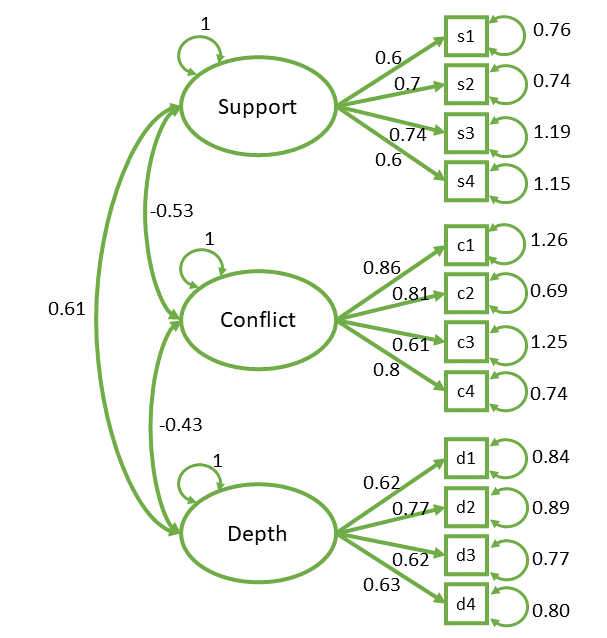
summary(mymod.est)
lavaan 0.6-19 ended normally after 19 iterations

  Estimator                                         ML
  Optimization method                           NLMINB
  Number of model parameters                        27

  Number of observations                           374

Model Test User Model:
                                                      
  Test statistic                                81.100
  Degrees of freedom                                51
  P-value (Chi-square)                           0.005

Parameter Estimates:

  Standard errors                             Standard
  Information                                 Expected
  Information saturated (h1) model          Structured

Latent Variables:
                   Estimate  Std.Err  z-value  P(>|z|)
  support =~                                          
    s1                0.601    0.062    9.765    0.000
    s2                0.707    0.064   11.010    0.000
    s3                0.642    0.074    8.676    0.000
    s4                0.608    0.072    8.407    0.000
  conflict =~                                         
    c1                0.860    0.077   11.102    0.000
    c2                0.810    0.063   12.909    0.000
    c3                0.614    0.072    8.532    0.000
    c4                0.808    0.064   12.673    0.000
  depth =~                                            
    d1                0.617    0.063    9.759    0.000
    d2                0.770    0.069   11.175    0.000
    d3                0.621    0.061   10.119    0.000
    d4                0.634    0.062   10.143    0.000

Covariances:
                   Estimate  Std.Err  z-value  P(>|z|)
  support ~~                                          
    conflict         -0.530    0.063   -8.473    0.000
    depth             0.613    0.062    9.956    0.000
  conflict ~~                                         
    depth            -0.425    0.065   -6.551    0.000

Variances:
                   Estimate  Std.Err  z-value  P(>|z|)
   .s1                0.763    0.070   10.860    0.000
   .s2                0.738    0.077    9.626    0.000
   .s3                1.188    0.102   11.625    0.000
   .s4                1.151    0.098   11.781    0.000
   .c1                1.259    0.116   10.893    0.000
   .c2                0.692    0.076    9.128    0.000
   .c3                1.251    0.102   12.276    0.000
   .c4                0.735    0.078    9.409    0.000
   .d1                0.839    0.075   11.146    0.000
   .d2                0.885    0.089    9.923    0.000
   .d3                0.771    0.071   10.880    0.000
   .d4                0.797    0.073   10.861    0.000
    support           1.000                           
    conflict          1.000                           
    depth             1.000                           

latent variable scaling

  • the latent factor is unobserved

  • its scale doesn’t exist - we need to fix it to something.

We can…

fix its variance to 1 (as previous slides).

std.lv = TRUE >> latent variables are standardised

mymod.est <- cfa(mymod, data = qri, std.lv = TRUE)
summary(mymod.est)
lavaan 0.6-19 ended normally after 19 iterations

  Estimator                                         ML
  Optimization method                           NLMINB
  Number of model parameters                        27

  Number of observations                           374

Model Test User Model:
                                                      
  Test statistic                                81.100
  Degrees of freedom                                51
  P-value (Chi-square)                           0.005

Parameter Estimates:

  Standard errors                             Standard
  Information                                 Expected
  Information saturated (h1) model          Structured

Latent Variables:
                   Estimate  Std.Err  z-value  P(>|z|)
  support =~                                          
    s1                0.601    0.062    9.765    0.000
    s2                0.707    0.064   11.010    0.000
    s3                0.642    0.074    8.676    0.000
    s4                0.608    0.072    8.407    0.000
  conflict =~                                         
    c1                0.860    0.077   11.102    0.000
    c2                0.810    0.063   12.909    0.000
    c3                0.614    0.072    8.532    0.000
    c4                0.808    0.064   12.673    0.000
  depth =~                                            
    d1                0.617    0.063    9.759    0.000
    d2                0.770    0.069   11.175    0.000
    d3                0.621    0.061   10.119    0.000
    d4                0.634    0.062   10.143    0.000

Covariances:
                   Estimate  Std.Err  z-value  P(>|z|)
  support ~~                                          
    conflict         -0.530    0.063   -8.473    0.000
    depth             0.613    0.062    9.956    0.000
  conflict ~~                                         
    depth            -0.425    0.065   -6.551    0.000

Variances:
                   Estimate  Std.Err  z-value  P(>|z|)
   .s1                0.763    0.070   10.860    0.000
   .s2                0.738    0.077    9.626    0.000
   .s3                1.188    0.102   11.625    0.000
   .s4                1.151    0.098   11.781    0.000
   .c1                1.259    0.116   10.893    0.000
   .c2                0.692    0.076    9.128    0.000
   .c3                1.251    0.102   12.276    0.000
   .c4                0.735    0.078    9.409    0.000
   .d1                0.839    0.075   11.146    0.000
   .d2                0.885    0.089    9.923    0.000
   .d3                0.771    0.071   10.880    0.000
   .d4                0.797    0.073   10.861    0.000
    support           1.000                           
    conflict          1.000                           
    depth             1.000                           

latent variable scaling (marker method)

  • the latent factor is unobserved

  • its scale doesn’t exist - we need to fix it to something.

We can…

fix it to having the same scale as one of the items (defaults to the first one).

the default in lavaan

mymod.est <- cfa(mymod, data = qri)
summary(mymod.est)
lavaan 0.6-19 ended normally after 37 iterations

  Estimator                                         ML
  Optimization method                           NLMINB
  Number of model parameters                        27

  Number of observations                           374

Model Test User Model:
                                                      
  Test statistic                                81.100
  Degrees of freedom                                51
  P-value (Chi-square)                           0.005

Parameter Estimates:

  Standard errors                             Standard
  Information                                 Expected
  Information saturated (h1) model          Structured

Latent Variables:
                   Estimate  Std.Err  z-value  P(>|z|)
  support =~                                          
    s1                1.000                           
    s2                1.177    0.155    7.588    0.000
    s3                1.070    0.158    6.759    0.000
    s4                1.013    0.153    6.633    0.000
  conflict =~                                         
    c1                1.000                           
    c2                0.942    0.104    9.025    0.000
    c3                0.714    0.100    7.150    0.000
    c4                0.940    0.105    8.972    0.000
  depth =~                                            
    d1                1.000                           
    d2                1.247    0.162    7.702    0.000
    d3                1.007    0.137    7.374    0.000
    d4                1.027    0.139    7.383    0.000

Covariances:
                   Estimate  Std.Err  z-value  P(>|z|)
  support ~~                                          
    conflict         -0.274    0.052   -5.293    0.000
    depth             0.227    0.042    5.450    0.000
  conflict ~~                                         
    depth            -0.226    0.048   -4.678    0.000

Variances:
                   Estimate  Std.Err  z-value  P(>|z|)
   .s1                0.763    0.070   10.860    0.000
   .s2                0.738    0.077    9.626    0.000
   .s3                1.188    0.102   11.625    0.000
   .s4                1.151    0.098   11.781    0.000
   .c1                1.259    0.116   10.893    0.000
   .c2                0.692    0.076    9.128    0.000
   .c3                1.251    0.102   12.276    0.000
   .c4                0.735    0.078    9.409    0.000
   .d1                0.839    0.075   11.146    0.000
   .d2                0.885    0.089    9.923    0.000
   .d3                0.771    0.071   10.880    0.000
   .d4                0.797    0.073   10.861    0.000
    support           0.361    0.074    4.883    0.000
    conflict          0.740    0.133    5.551    0.000
    depth             0.381    0.078    4.880    0.000

latent variable scaling (its all the same)

mymod.est <- cfa(mymod, data = qri)
mymod.est1 <- cfa(mymod, data = qri, std.lv = TRUE)

lavTestLRT(mymod.est, mymod.est1)

Chi-Squared Difference Test

           Df   AIC   BIC Chisq Chisq diff RMSEA Df diff Pr(>Chisq)
mymod.est  51 13489 13595  81.1                                    
mymod.est1 51 13489 13595  81.1  -1.02e-09     0       0           

standardisation

  • Back with EFA, we were working with correlations
    • everything was already standardised
  • Now we are working with covariances
    • model parameters depend on the scales of the variables

standardisation

  • Std.lv column = latent variables are standardised, observed variables aren’t
  • Std.all column = both latent variables and observed variables are standardised
mymod.est <- cfa(mymod, data = qri)
summary(mymod.est, std = TRUE)
lavaan 0.6-19 ended normally after 37 iterations

  Estimator                                         ML
  Optimization method                           NLMINB
  Number of model parameters                        27

  Number of observations                           374

Model Test User Model:
                                                      
  Test statistic                                81.100
  Degrees of freedom                                51
  P-value (Chi-square)                           0.005

Parameter Estimates:

  Standard errors                             Standard
  Information                                 Expected
  Information saturated (h1) model          Structured

Latent Variables:
                   Estimate  Std.Err  z-value  P(>|z|)   Std.lv  Std.all
  support =~                                                            
    s1                1.000                               0.601    0.567
    s2                1.177    0.155    7.588    0.000    0.707    0.636
    s3                1.070    0.158    6.759    0.000    0.642    0.508
    s4                1.013    0.153    6.633    0.000    0.608    0.493
  conflict =~                                                           
    c1                1.000                               0.860    0.608
    c2                0.942    0.104    9.025    0.000    0.810    0.698
    c3                0.714    0.100    7.150    0.000    0.614    0.481
    c4                0.940    0.105    8.972    0.000    0.808    0.686
  depth =~                                                              
    d1                1.000                               0.617    0.559
    d2                1.247    0.162    7.702    0.000    0.770    0.633
    d3                1.007    0.137    7.374    0.000    0.621    0.578
    d4                1.027    0.139    7.383    0.000    0.634    0.579

Covariances:
                   Estimate  Std.Err  z-value  P(>|z|)   Std.lv  Std.all
  support ~~                                                            
    conflict         -0.274    0.052   -5.293    0.000   -0.530   -0.530
    depth             0.227    0.042    5.450    0.000    0.613    0.613
  conflict ~~                                                           
    depth            -0.226    0.048   -4.678    0.000   -0.425   -0.425

Variances:
                   Estimate  Std.Err  z-value  P(>|z|)   Std.lv  Std.all
   .s1                0.763    0.070   10.860    0.000    0.763    0.679
   .s2                0.738    0.077    9.626    0.000    0.738    0.596
   .s3                1.188    0.102   11.625    0.000    1.188    0.742
   .s4                1.151    0.098   11.781    0.000    1.151    0.757
   .c1                1.259    0.116   10.893    0.000    1.259    0.630
   .c2                0.692    0.076    9.128    0.000    0.692    0.513
   .c3                1.251    0.102   12.276    0.000    1.251    0.768
   .c4                0.735    0.078    9.409    0.000    0.735    0.529
   .d1                0.839    0.075   11.146    0.000    0.839    0.688
   .d2                0.885    0.089    9.923    0.000    0.885    0.599
   .d3                0.771    0.071   10.880    0.000    0.771    0.666
   .d4                0.797    0.073   10.861    0.000    0.797    0.665
    support           0.361    0.074    4.883    0.000    1.000    1.000
    conflict          0.740    0.133    5.551    0.000    1.000    1.000
    depth             0.381    0.078    4.880    0.000    1.000    1.000

model fit & idenfication

The steps of CFA1

  1. measures, assumptions, data
  2. specification ✓
  3. identification
  4. estimation ✓
  5. fit
  6. possible respecification
  7. interpretation

what is model fit?

“how well does my model reproduce my outcome?”

Previous models (lm, lmer):

  • outcome = a single variable

\[ \begin{align} \text{outcome} &= \text{model} &+ \text{error} \\ \quad \\ \text{observed variable} & = \text{coefficients and predictor variables} &+ \text{error} \\ \quad \\ \text{observed variable} & = \text{model predicted values} &+ \text{error} \\ \end{align} \]

CFA1

  • outcome = a covariance matrix

\[ \begin{align} \text{outcome} &= \text{model} &+ \text{error} \\ \quad \\ \text{observed covariance matrix} & = \text{model parameters} &+ \text{error} \\ \quad \\ \text{observed covariance matrix} & = \text{model implied covariance matrix} &+ \text{error} \\ \end{align} \]

what are the model parameters?

the estimated paths on the diagram!

how does a diagram imply a covariance?
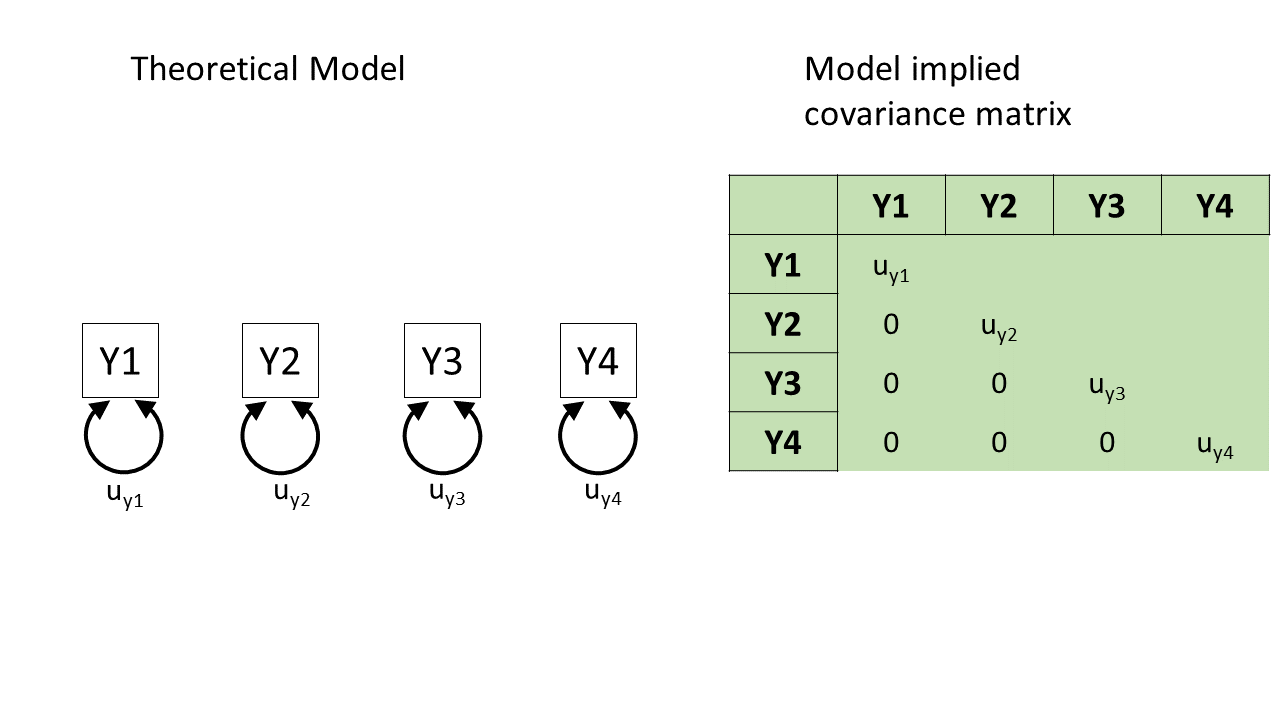
how does a diagram imply a covariance? (2)
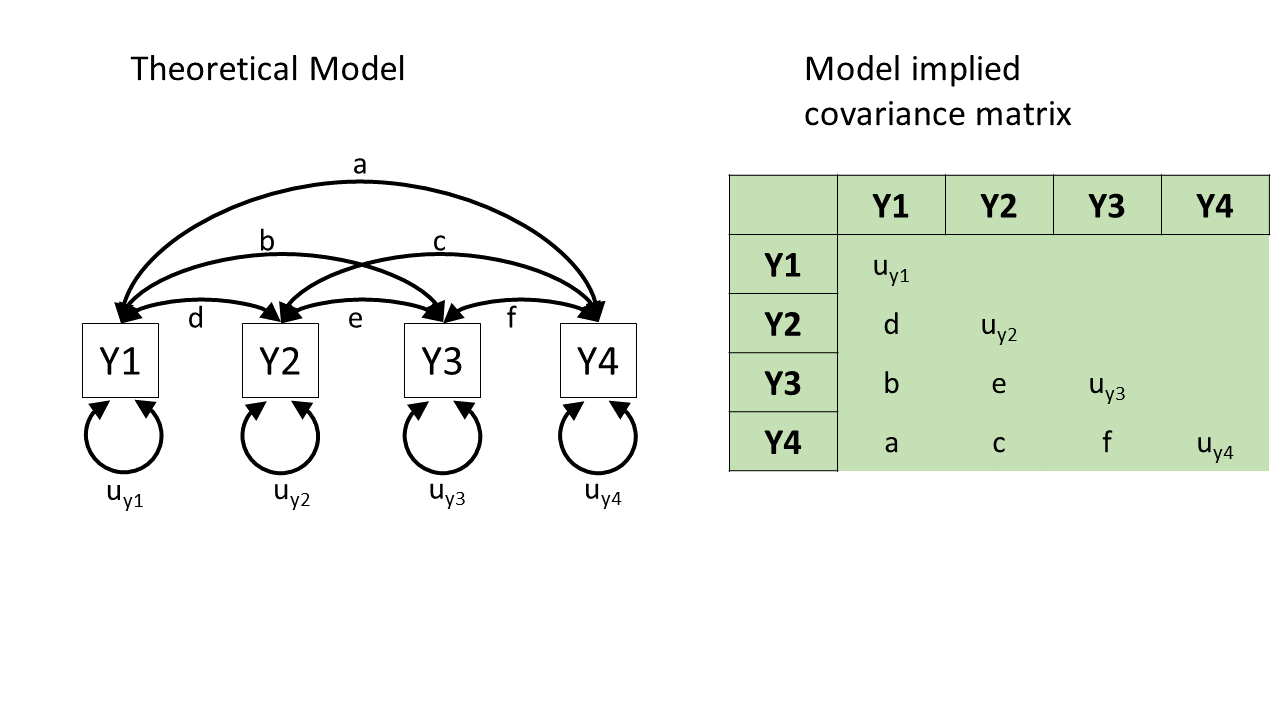
how does a diagram imply a covariance? (3)
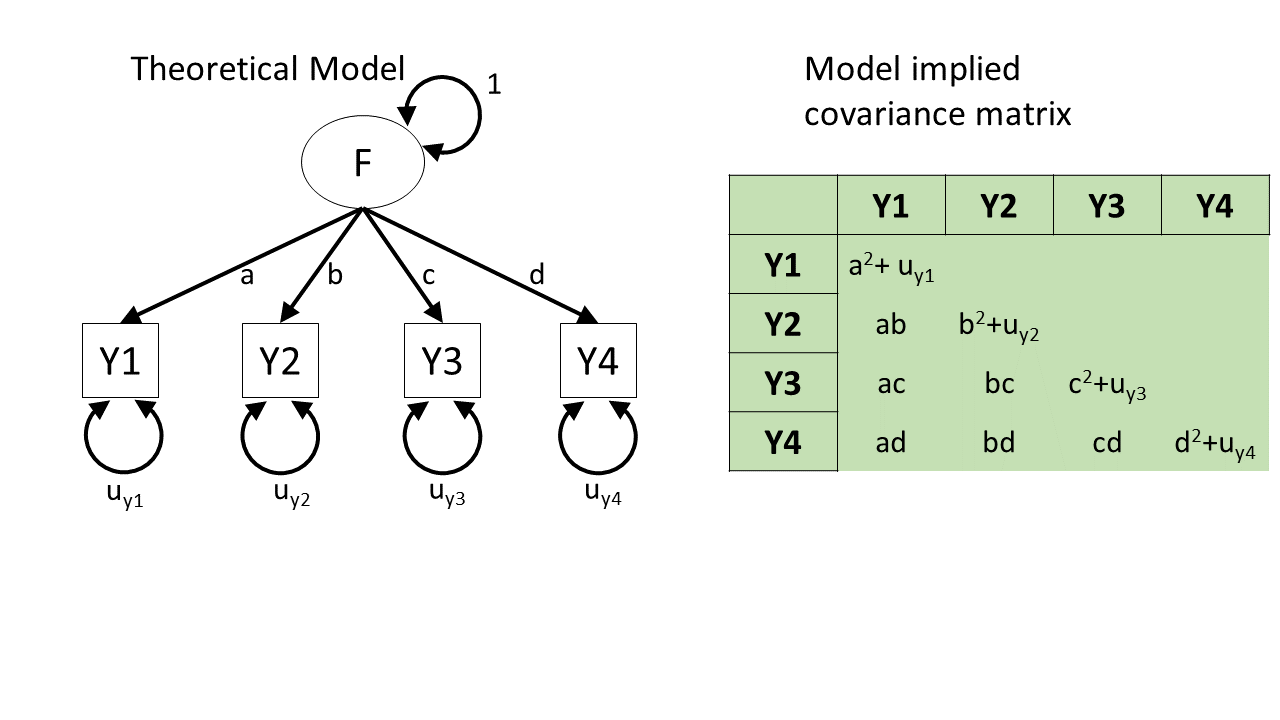
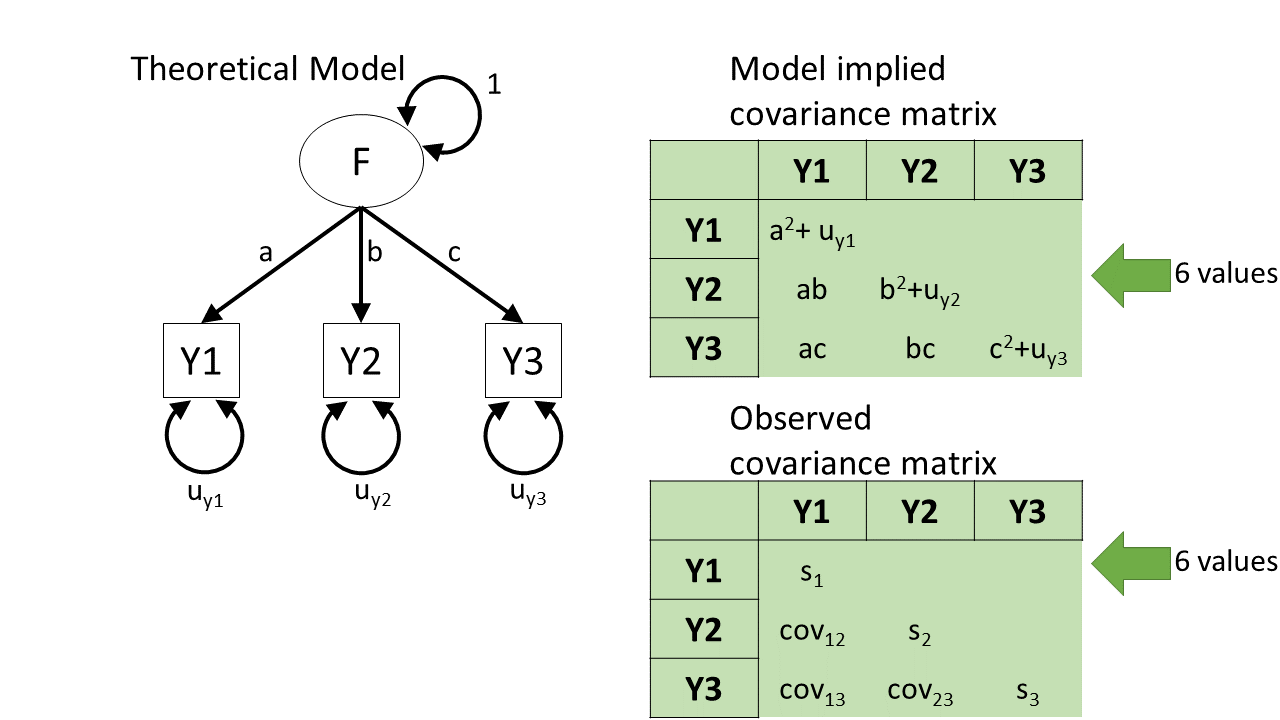
identifiability
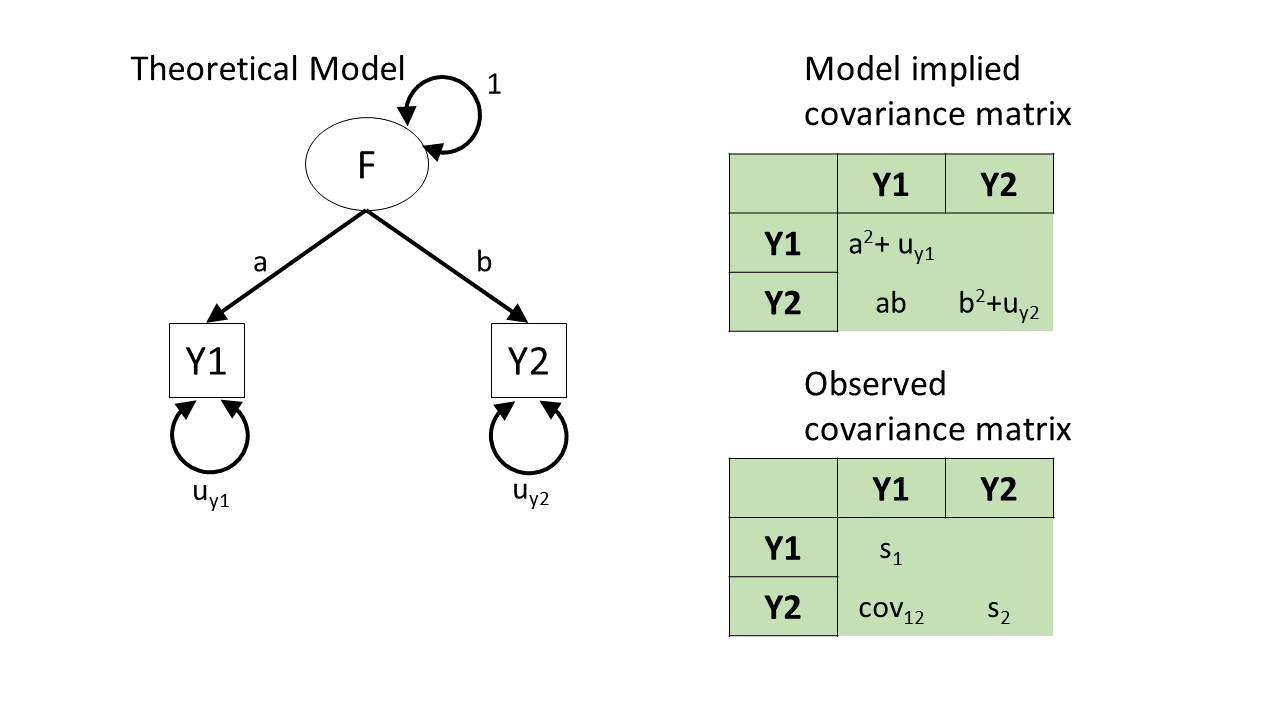
identifiability (2)
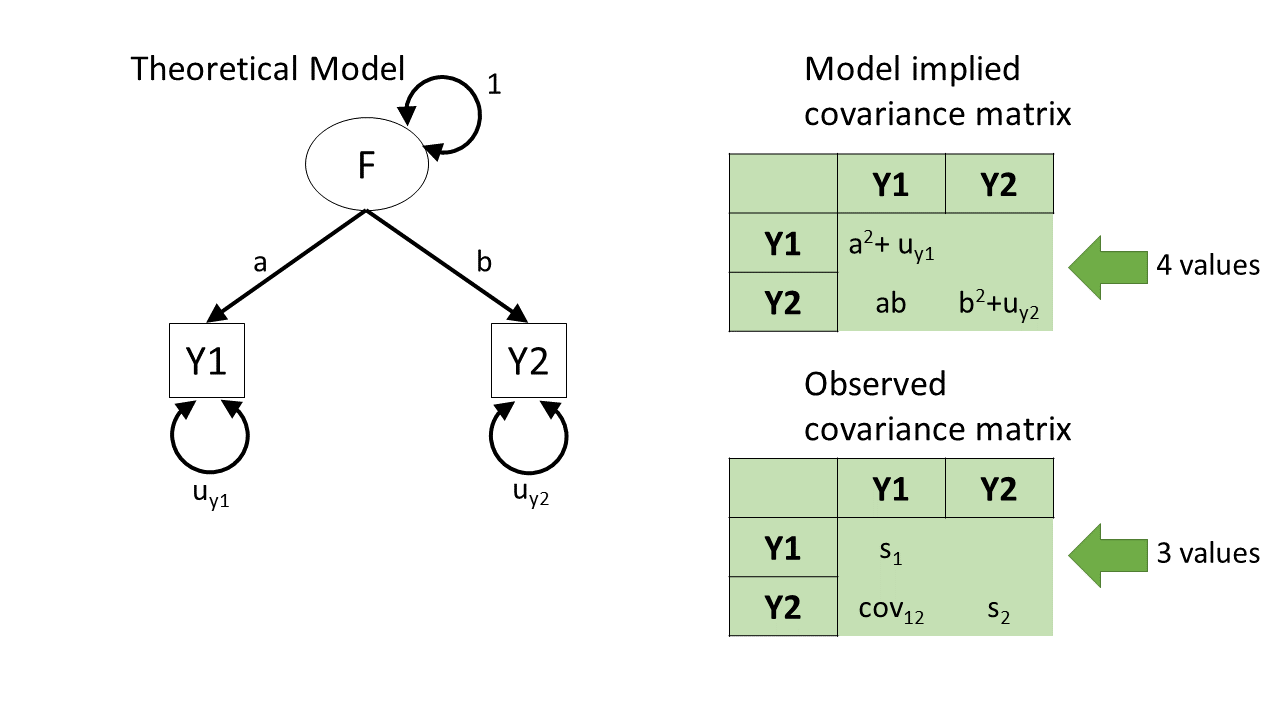
identifiability (3)
identifiability (4)

Conceptually:

  • Back in linear regression world - with just two datapoints there is only one line we can draw.
    • we start with 2 datapoints, and we estimate 2 things (intercept and slope).

  • In CFA world, the same applies for a factor with 3 ‘indicators’ (items)
    • we start with 6 values, and we estimate 6 things


To measure ‘model fit’ we need to observe more things than we estimate

degrees of freedom

how many “knowns”?

  • how many values in our covariance matrix?

  • for \(k\) variables this is \(\frac{k(k+1)}{2}\)

how many “unknowns”?

  • how many parameters are we estimating with our model?


degrees of freedom = knowns - unknowns

example: QRI

how many “knowns”?

cov(qri) |>
  round(2)
      s2    d4    c3    c4    d1    c2    s1    s4    d2    c1    s3    d3
s2  1.24  0.32 -0.26 -0.24  0.22 -0.21  0.46  0.39  0.39 -0.46  0.44  0.31
d4  0.32  1.20 -0.19 -0.10  0.39 -0.20  0.20  0.29  0.47 -0.40  0.24  0.41
c3 -0.26 -0.19  1.63  0.41 -0.24  0.43 -0.31 -0.32 -0.34  0.68 -0.24 -0.29
c4 -0.24 -0.10  0.41  1.39 -0.15  0.78 -0.24 -0.24 -0.16  0.62 -0.29 -0.14
d1  0.22  0.39 -0.24 -0.15  1.22 -0.22  0.19  0.16  0.51 -0.42  0.24  0.38
c2 -0.21 -0.20  0.43  0.78 -0.22  1.35 -0.18 -0.18 -0.17  0.62 -0.26 -0.20
s1  0.46  0.20 -0.31 -0.24  0.19 -0.18  1.13  0.36  0.28 -0.38  0.37  0.20
s4  0.39  0.29 -0.32 -0.24  0.16 -0.18  0.36  1.53  0.29 -0.45  0.45  0.24
d2  0.39  0.47 -0.34 -0.16  0.51 -0.17  0.28  0.29  1.48 -0.37  0.32  0.46
c1 -0.46 -0.40  0.68  0.62 -0.42  0.62 -0.38 -0.45 -0.37  2.00 -0.30 -0.32
s3  0.44  0.24 -0.24 -0.29  0.24 -0.26  0.37  0.45  0.32 -0.30  1.61  0.23
d3  0.31  0.41 -0.29 -0.14  0.38 -0.20  0.20  0.24  0.46 -0.32  0.23  1.16

how many “unknowns”?

example: QRI

how many “knowns”?

78 variances and covariances

  • 12 observed variables
  • (12 x 13) / 2 = 78

how many “unknowns”?

27 estimated parameters

  • 12 factor loadings
  • 12 residual variances
  • 3 factor correlations
  • 3 factor variances (fixed to 1)
summary(mymod.est)
lavaan 0.6-19 ended normally after 37 iterations

  Estimator                                         ML
  Optimization method                           NLMINB
  Number of model parameters                        27

  Number of observations                           374

Model Test User Model:
                                                      
  Test statistic                                81.100
  Degrees of freedom                                51
  P-value (Chi-square)                           0.005

Parameter Estimates:

  Standard errors                             Standard
  Information                                 Expected
  Information saturated (h1) model          Structured

Latent Variables:
                   Estimate  Std.Err  z-value  P(>|z|)
  support =~                                          
    s1                1.000                           
    s2                1.177    0.155    7.588    0.000
    s3                1.070    0.158    6.759    0.000
    s4                1.013    0.153    6.633    0.000
  conflict =~                                         
    c1                1.000                           
    c2                0.942    0.104    9.025    0.000
    c3                0.714    0.100    7.150    0.000
    c4                0.940    0.105    8.972    0.000
  depth =~                                            
    d1                1.000                           
    d2                1.247    0.162    7.702    0.000
    d3                1.007    0.137    7.374    0.000
    d4                1.027    0.139    7.383    0.000

Covariances:
                   Estimate  Std.Err  z-value  P(>|z|)
  support ~~                                          
    conflict         -0.274    0.052   -5.293    0.000
    depth             0.227    0.042    5.450    0.000
  conflict ~~                                         
    depth            -0.226    0.048   -4.678    0.000

Variances:
                   Estimate  Std.Err  z-value  P(>|z|)
   .s1                0.763    0.070   10.860    0.000
   .s2                0.738    0.077    9.626    0.000
   .s3                1.188    0.102   11.625    0.000
   .s4                1.151    0.098   11.781    0.000
   .c1                1.259    0.116   10.893    0.000
   .c2                0.692    0.076    9.128    0.000
   .c3                1.251    0.102   12.276    0.000
   .c4                0.735    0.078    9.409    0.000
   .d1                0.839    0.075   11.146    0.000
   .d2                0.885    0.089    9.923    0.000
   .d3                0.771    0.071   10.880    0.000
   .d4                0.797    0.073   10.861    0.000
    support           0.361    0.074    4.883    0.000
    conflict          0.740    0.133    5.551    0.000
    depth             0.381    0.078    4.880    0.000

model fit

Pretty much all based on:
\[ \begin{align} \text{observed covariance matrix}\,\,\, vs \,\,\, \text{model implied covariance matrix}\\ \end{align} \]

typically also incorporate degrees of freedom (these represent model complexity/parsimony)

fit indices

there are loooooooaddds of different metrics…

“absolute fit”

“how far from perfect fit?”

smaller is better

fit index common threshold
RMSEA <0.05
SRMR <0.05/<0.08

“incremental fit”

“how much better than a null model1?”

bigger is better

fit index common threshold
TLI >0.95
CFI >0.95


In R:

fitmeasures(mymod.est)[c("rmsea","srmr","cfi","tli")]

 rmsea   srmr    cfi    tli 
0.0397 0.0467 0.9619 0.9508 

The steps of CFA1

  1. measures, assumptions, data
  2. specification ✓
  3. identification ✓
  4. estimation ✓
  5. fit ✓
  6. possible respecification ⚠
  7. interpretation

model respecification

modification indices

“how much better would my model fit if we included parameter x?”

but..

  • adding in parameters will always improve model fit
  • and we lose degrees of freedom
    • model complexity, model simplicity
  • these should be theoretically justified

modindices()

  • lhs, op, rhs = the parameter
  • mi = change in fit
  • epc, sepc.lv, sepc.all, sepc.nox = expected value of parameter (under various forms of standardisation)
modindices(mymod.est, sort = TRUE)
         lhs op rhs     mi    epc sepc.lv sepc.all sepc.nox
101       c2 ~~  c4 50.316  0.561   0.561    0.787    0.787
51     depth =~  c1 15.882 -0.612  -0.378   -0.267   -0.267
31   support =~  c1 14.774 -0.695  -0.417   -0.295   -0.295
54     depth =~  c4 12.504  0.457   0.282    0.239    0.239
32   support =~  c2  9.875  0.478   0.287    0.247    0.247
94        c1 ~~  c3  8.577  0.237   0.237    0.189    0.189
93        c1 ~~  c2  8.101 -0.241  -0.241   -0.258   -0.258
95        c1 ~~  c4  7.628 -0.234  -0.234   -0.243   -0.243
53     depth =~  c3  6.143 -0.351  -0.216   -0.170   -0.170
106       c3 ~~  c4  6.027 -0.170  -0.170   -0.177   -0.177
33   support =~  c3  5.216 -0.378  -0.227   -0.178   -0.178
100       c2 ~~  c3  3.797 -0.134  -0.134   -0.144   -0.144
34   support =~  c4  3.637  0.293   0.176    0.149    0.149
96        c1 ~~  d1  3.523 -0.116  -0.116   -0.113   -0.113
99        c1 ~~  d4  3.320 -0.111  -0.111   -0.111   -0.111
114       c4 ~~  d4  3.179  0.087   0.087    0.114    0.114
52     depth =~  c2  2.985  0.221   0.136    0.117    0.117
68        s2 ~~  c1  2.819 -0.103  -0.103   -0.107   -0.107
108       c3 ~~  d2  2.611 -0.102  -0.102   -0.097   -0.097
85        s4 ~~  c1  2.474 -0.112  -0.112   -0.093   -0.093
103       c2 ~~  d2  2.117  0.076   0.076    0.097    0.097
59        s1 ~~  c2  2.114  0.069   0.069    0.095    0.095
60        s1 ~~  c3  1.940 -0.079  -0.079   -0.081   -0.081
86        s4 ~~  c2  1.895  0.078   0.078    0.087    0.087
77        s3 ~~  c1  1.835  0.099   0.099    0.081    0.081
109       c3 ~~  d3  1.748 -0.076  -0.076   -0.077   -0.077
67        s2 ~~  s4  1.658 -0.089  -0.089   -0.096   -0.096
69        s2 ~~  c2  1.603  0.062   0.062    0.086    0.086
89        s4 ~~  d1  1.592 -0.073  -0.073   -0.074   -0.074
55        s1 ~~  s2  1.525  0.078   0.078    0.103    0.103
35   support =~  d1  1.494 -0.212  -0.127   -0.115   -0.115
72        s2 ~~  d1  1.414 -0.060  -0.060   -0.076   -0.076
47     depth =~  s1  1.403 -0.198  -0.122   -0.115   -0.115
48     depth =~  s2  1.326  0.212   0.131    0.117    0.117
87        s4 ~~  c3  1.326 -0.078  -0.078   -0.065   -0.065
76        s3 ~~  s4  1.244  0.083   0.083    0.071    0.071
92        s4 ~~  d4  1.145  0.061   0.061    0.064    0.064
115       d1 ~~  d2  0.991  0.067   0.067    0.078    0.078
80        s3 ~~  c4  0.971 -0.058  -0.058   -0.062   -0.062
111       c4 ~~  d1  0.853  0.046   0.046    0.059    0.059
73        s2 ~~  d2  0.779  0.048   0.048    0.059    0.059
75        s2 ~~  d4  0.743  0.043   0.043    0.056    0.056
110       c3 ~~  d4  0.682  0.048   0.048    0.048    0.048
65        s1 ~~  d4  0.678 -0.039  -0.039   -0.051   -0.051
44  conflict =~  d2  0.667  0.080   0.069    0.057    0.057
58        s1 ~~  c1  0.660 -0.049  -0.049   -0.050   -0.050
71        s2 ~~  c4  0.616  0.039   0.039    0.053    0.053
113       c4 ~~  d3  0.574  0.036   0.036    0.048    0.048
43  conflict =~  d1  0.558 -0.065  -0.056   -0.051   -0.051
74        s2 ~~  d3  0.541  0.036   0.036    0.047    0.047
40  conflict =~  s2  0.521  0.078   0.067    0.060    0.060
112       c4 ~~  d2  0.493  0.037   0.037    0.046    0.046
64        s1 ~~  d3  0.371 -0.029  -0.029   -0.037   -0.037
78        s3 ~~  c2  0.370 -0.035  -0.035   -0.039   -0.039
118       d2 ~~  d3  0.360 -0.040  -0.040   -0.048   -0.048
119       d2 ~~  d4  0.340 -0.039  -0.039   -0.047   -0.047
102       c2 ~~  d1  0.304 -0.027  -0.027   -0.035   -0.035
36   support =~  d2  0.304  0.109   0.065    0.054    0.054
42  conflict =~  s4  0.285 -0.060  -0.052   -0.042   -0.042
66        s2 ~~  s3  0.263 -0.037  -0.037   -0.039   -0.039
120       d3 ~~  d4  0.259  0.029   0.029    0.037    0.037
56        s1 ~~  s3  0.190 -0.028  -0.028   -0.030   -0.030
84        s3 ~~  d4  0.175 -0.024  -0.024   -0.025   -0.025
38   support =~  d4  0.173  0.072   0.043    0.039    0.039
105       c2 ~~  d4  0.166 -0.020  -0.020   -0.026   -0.026
83        s3 ~~  d3  0.158 -0.023  -0.023   -0.024   -0.024
79        s3 ~~  c3  0.152  0.027   0.027    0.022    0.022
81        s3 ~~  d1  0.147  0.023   0.023    0.023    0.023
45  conflict =~  d3  0.104 -0.028  -0.024   -0.022   -0.022
70        s2 ~~  c3  0.085  0.017   0.017    0.018    0.018
104       c2 ~~  d3  0.074 -0.013  -0.013   -0.018   -0.018
82        s3 ~~  d2  0.042  0.013   0.013    0.013    0.013
91        s4 ~~  d3  0.040  0.011   0.011    0.012    0.012
61        s1 ~~  c4  0.039 -0.010  -0.010   -0.013   -0.013
37   support =~  d3  0.034  0.031   0.019    0.017    0.017
117       d1 ~~  d4  0.033 -0.011  -0.011   -0.013   -0.013
62        s1 ~~  d1  0.031 -0.009  -0.009   -0.011   -0.011
41  conflict =~  s3  0.030 -0.020  -0.017   -0.014   -0.014
46  conflict =~  d4  0.027  0.014   0.012    0.011    0.011
39  conflict =~  s1  0.023 -0.015  -0.013   -0.012   -0.012
49     depth =~  s3  0.021 -0.028  -0.017   -0.014   -0.014
88        s4 ~~  c4  0.019  0.008   0.008    0.009    0.009
63        s1 ~~  d2  0.017  0.007   0.007    0.008    0.008
116       d1 ~~  d3  0.014 -0.007  -0.007   -0.008   -0.008
107       c3 ~~  d1  0.011 -0.006  -0.006   -0.006   -0.006
50     depth =~  s4  0.009  0.018   0.011    0.009    0.009
98        c1 ~~  d3  0.005  0.004   0.004    0.004    0.004
97        c1 ~~  d2  0.004 -0.004  -0.004   -0.004   -0.004
57        s1 ~~  s4  0.003 -0.003  -0.003   -0.004   -0.004
90        s4 ~~  d2  0.002 -0.003  -0.003   -0.003   -0.003

modification indices

var wording
s1 To what extent could you turn to this person for advice about problems?
s2 To what extent could you count on this person for help with a problem?
s3 To what extent can you really count on this person to distract you from your worries when you feel under stress?
s4 To what extent can you count on this person to listen to you when you are very angry at someone else?
c1 How often do you have to work hard to avoid conflict with this person?
c2 How much do you argue with this person?
c3 How much would you like this person to change?
c4 How often does this person make you feel angry?
d1 How positive a role does this person play in your life?
d2 How significant is this relationship in your life?
d3 How close will your relationship be with this person in 10 years?
d4 How much would you miss this person if the two of you could not see or talk with each other for a month?

modification indices

Less contentious uses:

  • residual covariances for items within a factor
    • essentially asserts that the two observed variables share some of their specific variance

More contentious uses:

  • adding cross-loadings (could argue that an item loading on two factors is not a clean indicator, and so should be removed)

  • residual covariances for items on different factors - harder to defend

  • changing paths between the latent variables - very definitely changing your theory!

⚠ model modification is exploratory! ⚠

re-specifying a model is no longer confirmatory

it is exploratory again!

gaahhhh

interpretation

CFA interpretation

there are so many parts to these models that often the “interpretation” such as it is, will boil down to:

  1. does it fit well? (and did you have to specify additional paths?)
  2. are the standardised factor loadings big enough? (e.g., \(>|.3|\))

And then the bit we might be more interested in, things like:

  • does F1 correlate with F2?

that seemed like a lot of work

All of this, just to test if a theoretical model of a measurement tool is replicated in your sample?

CFA is a gateway…

beyond this point

stuff beyond here definitely won’t be in the exam or in the quiz.

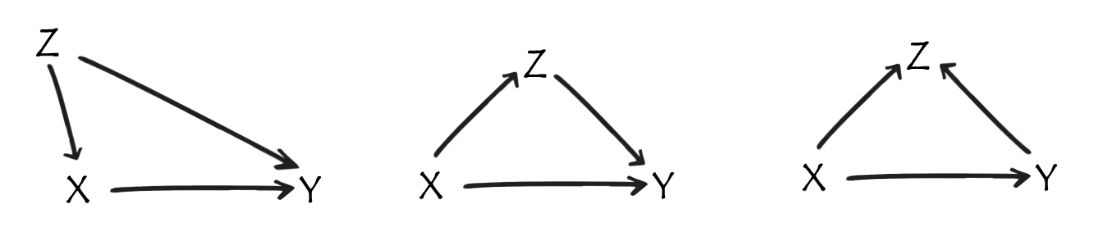
graphical models

  • there’s a formal logic to diagrams (“do-calculus”).

  • mainly for back-of-envelope thinking

  • essentially a way of helping to figure out how to get at an unbiased estimate of the thing we are interested in.

  • helps with thinking about any part of a study that is observed not manipulated/randomly allocated

  • I surreptitiously introduced you to this way of thinking in back in Week 1!
Structural Equation Models (SEM)

(essentially just diagrams where the paths are linear associations)

  • there’s a formal algebra to the linear paths

  • this “covariance algebra” tells us what the model implied covariances are

    • we can also do it by tracing along paths in the diagram!

Uses:

  1. Testing theories beyond just those about measurement. Essentially, draw lines between variables and ask “how well does this reproduce the cov matrix?”.
  2. Estimating paths between constructs while explicitly modelling measurement error

error error everywhere

SEM

There’s error everywhere!
Models can have structural parts and measurement parts. It all gets estimated at once!
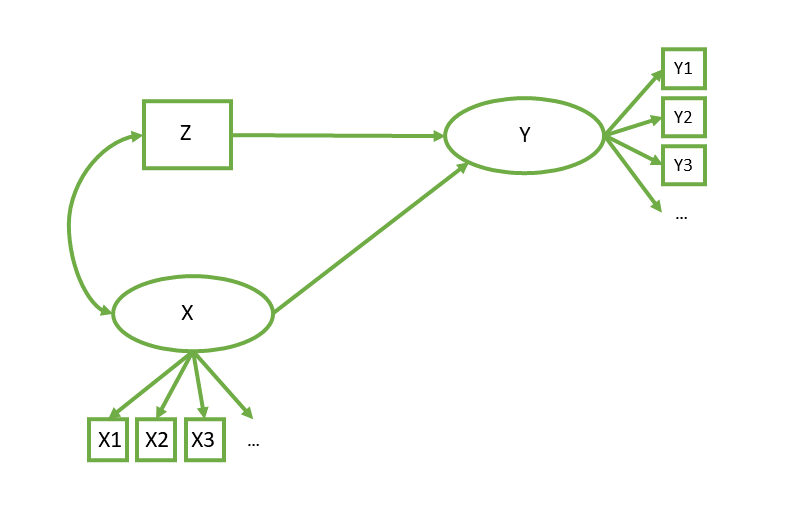
# measurement model
Y =~ y1 + y2 + y3 + ...
X =~ x1 + x2 + x3 + ...
# regressions
Y ~ X + Z
# covariances
X ~~ Z

common uses of SEM

“Nomological Net”
Do things correlate with other things we expect them to correlate with?
Good for assessing if our measure is measuring the thing we want it to measure!
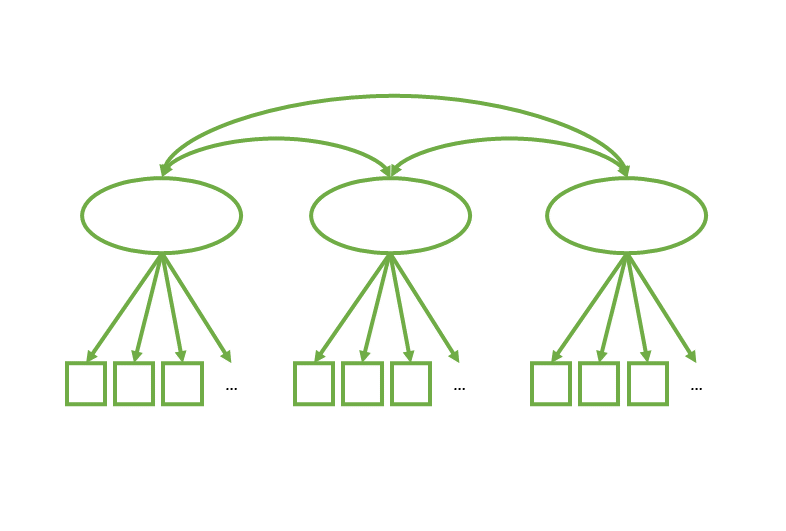

# measurement model
F1 =~ y1 + y2 + y3 + ...
F2 =~ x1 + x2 + x3 + ...
F3 =~ w1 + w2 + w3 + ...
# latent variable covariances
F1 ~~ F2
F1 ~~ F3
F2 ~~ F3

common uses of SEM

Measurement Invariance
Do factor loadings differ between groups/timepoints/contexts?
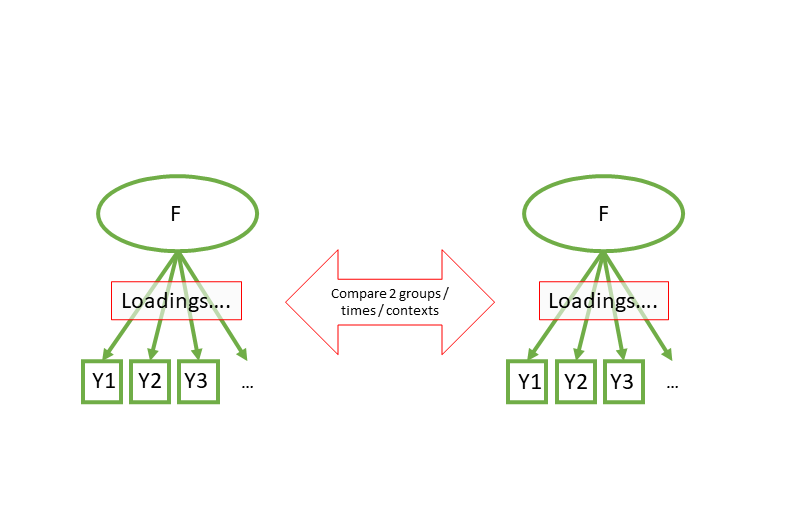

F1 =~ y1 + y2 + y3 + ...


m1 <- cfa(model, data, group = "mygroups")
m2 <- cfa(model, data, group = "mygroups", 
                 group.equal = "loadings")  
  
semTools::compareFit(m1,m2)

common uses of SEM

Mediation
How much of X -> Y is because of X -> M and M -> Y?
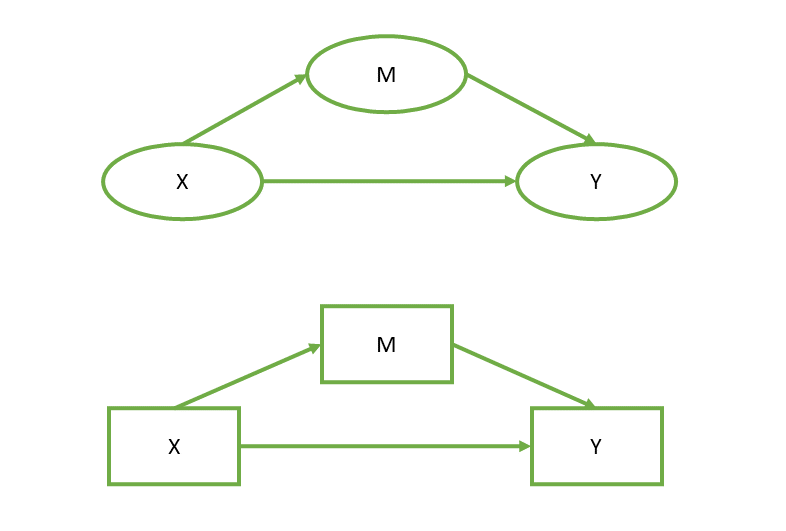

Y ~ a*M + c*X
M ~ b*X
indirect := a*b
direct := c
sem(model, data)

mediation is almost always incredibly problematic. Many people dismiss it altogether as essentially useless because confounding is everywhere.

cross-sectional observational mediation = “three correlations in a trenchcoat”1

common uses of SEM

Latent Growth Curves
The same as lmer(Y ~ TimePoint + (1 + TimePoint | Person))
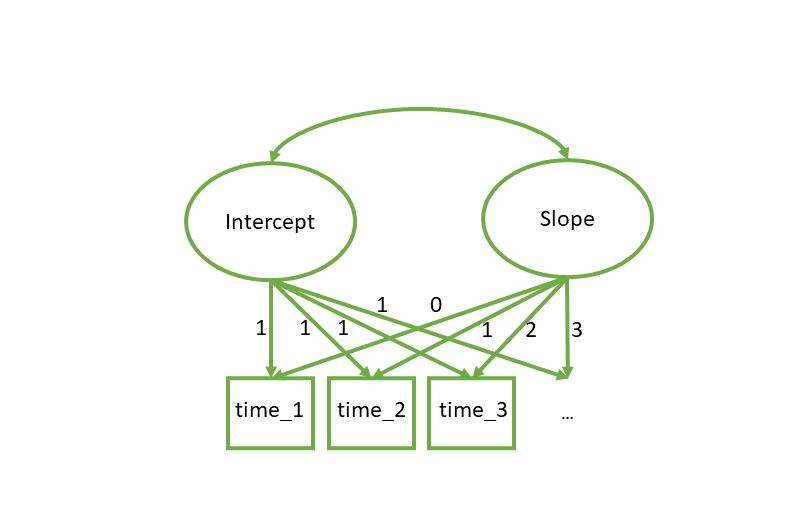

int =~ 1*Time1 + 1*Time2 + 1*Time3 + ...
slope =~ 0*Time1 + 1*Time2 + 2*Time3 + ...
int ~~ slope
growth(model, data)

This week

Take a look at the readings!!!

Attend the lab!!!

Come to office hours!!